
Salmonella outbreak grows to three clusters: what UKHSA now says
What happened
The UK Health Security Agency (UKHSA) updated its national Salmonella outbreak investigation on Wednesday 3 September 2026, and the numbers have grown. UKHSA is now tracking three separate clusters of Salmonella Enteritidis, working alongside the Food Standards Agency (FSA), Food Standards Scotland and other public health partners. As of 1 September 2026 the picture was: - Cluster t5.9411: 305 confirmed cases and 1 death, from samples taken between 11 August 2025 and 21 August 2026 - Cluster t0.24068: 182 confirmed cases and no deaths, from samples taken between 27 May 2025 and 15 August 2026 - Cluster t5.9765: 41 confirmed cases and 1 death, from samples taken between 27 January 2026 and 11 August 2026 The odd-looking codes are genetic fingerprints. Scientists sequence the whole genome of the bacteria from each patient, and cases that share a fingerprint are very likely to share a source. The first of these clusters was declared a national outbreak on 18 August 2026, when it stood at 207 confirmed cases. UKHSA had first noticed the rise back in May 2026. Investigators say the evidence so far points towards eggs imported into the UK, with many cases linked to eating out at small cafes, restaurants and takeaways. Hannah Charles, UKHSA's lead epidemiologist on the investigation, said: "Our investigation to date indicates a link to imported eggs, however this investigation remains ongoing." Professor Ian Young, Chief Scientific Adviser at the Food Standards Agency, was clear on one point that matters to shoppers: "There is no evidence that UK-produced eggs are affected."
Why this matters
Salmonella is common, and for most healthy adults it is a thoroughly miserable few days rather than a danger. Diarrhoea, stomach cramps, fever, sometimes vomiting, usually starting within a day or two of eating contaminated food and settling within a week without any treatment. But these clusters are not behaving like ordinary background cases. In the expert commentary published when the outbreak was declared, around 38% of people with available data had been admitted to hospital. That is a high proportion. Two people have now died across the three clusters. The other thing that stands out is the timescale. Sample dates stretch back to May and August 2025. This is not a single bad batch that came and went in a fortnight; it is a slow, grinding source that has kept producing cases for more than a year. UKHSA has also said this outbreak is genetically linked to a 2025 outbreak that was likewise traced to imported eggs. That has a practical consequence. Because the suspected route runs through catering businesses rather than supermarket shelves, there is no product you can simply take out of your fridge and throw away. Protection comes from how eggs are cooked and handled instead. It matters most for the people least able to shrug off a stomach bug: babies and young children, people who are pregnant, adults over 65, and anyone whose immune system is weakened by illness or treatment. For someone frail, a few days of severe diarrhoea can mean dehydration, a fall, or a hospital admission for something that started in the kitchen.
What the evidence actually says
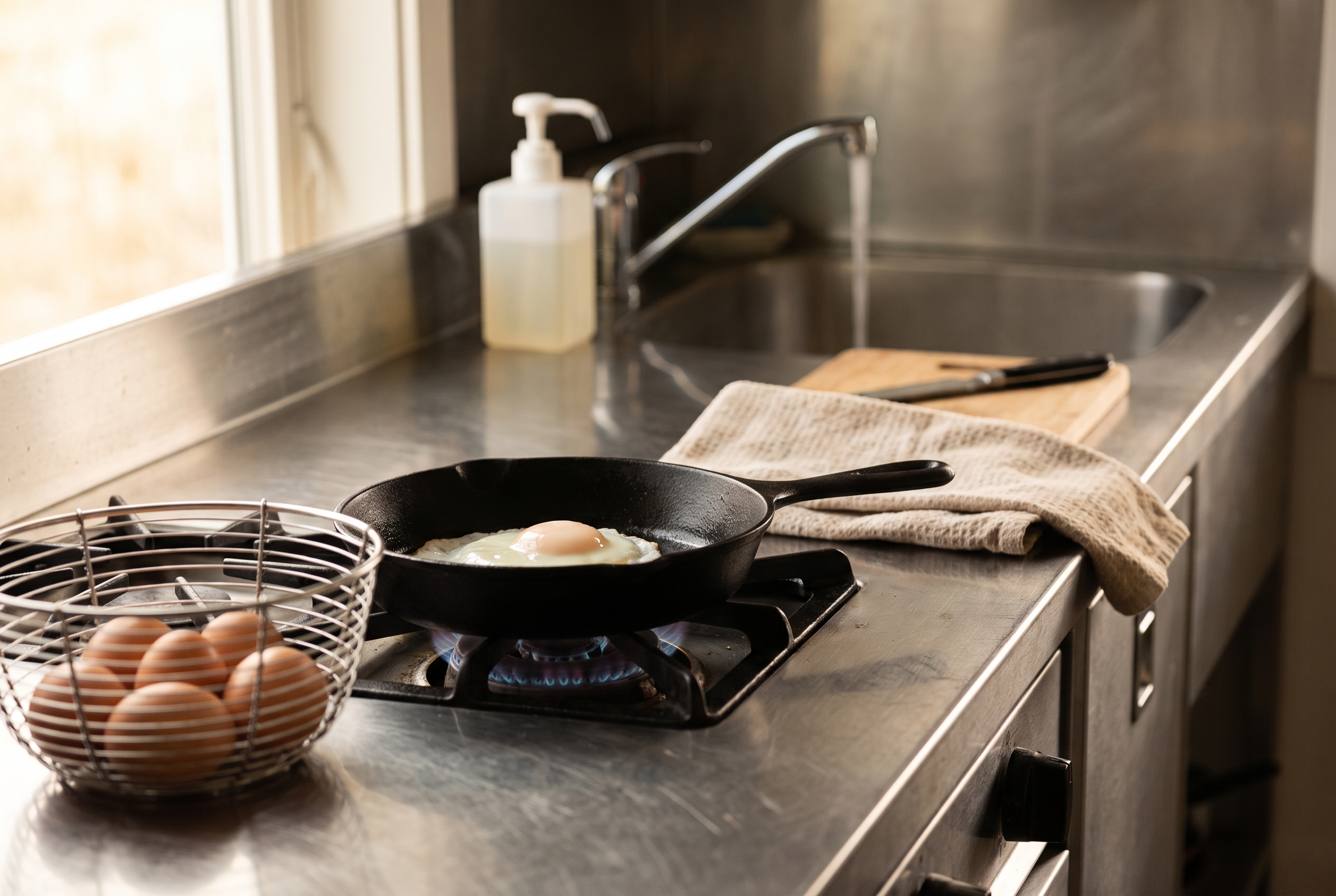
It is worth separating what is confirmed from what is still being worked out. Confirmed: there are three linked clusters, the case numbers above are UKHSA's own figures as of 1 September 2026, and two people have died. Confirmed: the FSA says there is no evidence that UK-produced eggs are affected. Still under investigation: the exact source. UKHSA's own wording is that the investigation "indicates a link to imported eggs" and "remains ongoing". No single supplier, country or business has been publicly named, and until that work finishes it would be wrong to assume anyone knows which eggs, from where. UKHSA has assessed the risk to the general public as low. That sits alongside the case numbers rather than contradicting them: several hundred confirmed cases across more than a year, in a country of 68 million, is a real problem for public health teams to solve and a small individual risk for any one person eating a fried egg. One detail from the expert commentary is genuinely useful for home cooks. Professor Owen Spiller suggested that "it is the contamination of cooking surfaces during food preparation that is likely causing this sustained level of cases". In other words, the danger may not only be the undercooked egg itself. It can be the shell touching a worktop, then a salad going down on the same spot. Dr Aidan Taylor summarised the protective steps as "cooking eggs thoroughly, washing hands after handling raw ingredients, avoiding cross-contamination between raw and ready-to-eat foods".
Qurexa perspective
We deliver both prescriptions and groceries across Lincolnshire, so this one sits squarely in our lane, and we want to be straightforward about it. Nothing in this outbreak is linked to eggs produced in the UK, and the FSA has said so plainly. If you buy British Lion marked eggs, keep them in the fridge and cook them properly, the advice below is simply good routine. Where we think we can be genuinely useful is with the customers we see most: people who are older, people managing several long-term conditions, and people who find getting to the shops difficult. Those are the same people for whom a bad bout of Salmonella is not a minor inconvenience. Two things are worth saying to them. First, if you are in a higher-risk group, this is the moment to stick to eggs with the British Lion mark or Laid in Britain assurance for anything raw or lightly cooked, and to have everything else cooked through. Second, if you do get a stomach bug, keep taking your regular medicines unless a doctor or pharmacist tells you otherwise, and drink more than feels necessary. Some medicines, including certain blood pressure tablets and diabetes medicines, may need temporary adjustment during severe diarrhoea or vomiting, which is exactly the kind of question a pharmacist can answer quickly. If we deliver your medicines and you are unwell, tell us and we will work around you. That is what the service is for.
Practical advice
This is UKHSA and FSA advice, in plain terms. Cooking eggs at home: - Cook eggs until both the white and the yolk are firm. That kills Salmonella. - If you are in a higher-risk group (babies and young children, pregnant, over 65, or immunocompromised), only eat raw or lightly cooked eggs if they carry the British Lion mark or are Laid in Britain assured. - Keep eggs in the fridge, away from other foods, and use them by the best before date. Stopping the spread around your kitchen: - Wash your hands with soap and warm water before handling food, and again straight after touching raw eggs, raw meat or poultry. - Wash and dry any surface, bowl or utensil that has touched raw egg before it touches anything else. - Do not put ready-to-eat food, like salad or bread, on a worktop where eggshells have been. Eating out: - Ask for eggs to be cooked all the way through. - Be cautious with dishes made from raw or lightly cooked egg: fresh mayonnaise, hollandaise, mousses, tiramisu, homemade ice cream and some cocktails. If you become ill: - Most people recover at home in under a week. Drink plenty of fluids in small, frequent sips. - Stay off work, school or nursery until 48 hours after your symptoms have stopped, and do not prepare food for others in that time. - Contact NHS 111 or your GP if there is blood in your diarrhoea, if you cannot keep fluids down, if you have a high fever, if symptoms last more than a week, or if the person affected is a baby, is pregnant, is elderly or has a weakened immune system.
What to know
On 3 September 2026, UKHSA updated its investigation into a national Salmonella Enteritidis outbreak. As of 1 September 2026 it covered three genetically linked clusters: 305 cases and 1 death, 182 cases and no deaths, and 41 cases and 1 death. The earliest samples date back to May 2025. Investigations point towards imported eggs, with many cases connected to small cafes, restaurants and takeaways. The Food Standards Agency says there is no evidence that UK-produced eggs are affected. The investigation is still ongoing and no source has been publicly confirmed. UKHSA assesses the risk to the general public as low, but the hospital admission rate among known cases has been high, at around 38% of those with available data. The protective steps are ordinary and effective: cook eggs until the white and yolk are firm, wash hands and surfaces after handling raw egg, keep raw and ready-to-eat food apart, and choose British Lion or Laid in Britain assured eggs for anything raw or lightly cooked if you are in a higher-risk group. Sources: UK Health Security Agency, "Salmonella outbreak update", GOV.UK, published 27 August 2026, last updated 3 September 2026, https://www.gov.uk/government/news/salmonella-outbreak-update; Science Media Centre, "Expert reaction to UK Salmonella outbreak", 18 August 2026, https://www.sciencemediacentre.org/expert-reaction-to-uk-salmonella-outbreak/; UK Health Security Agency, "What is Salmonella, and what can you do to avoid catching it?", UKHSA blog, 24 August 2026, https://ukhsa.blog.gov.uk/2026/08/24/what-is-salmonella-and-what-can-you-do-to-avoid-catching-it/ This article is for general information and does not replace advice from a doctor, pharmacist or other qualified healthcare professional. If you or someone you care for becomes seriously unwell, contact NHS 111 or your GP practice, or call 999 in an emergency.
Related articles
Invasive mosquitoes found breeding in east London: what it means
On Thursday 3 September 2026, the UK Health Security Agency (UKHSA) said it had found invasive Aedes aegypti mosquitoes, along with their larvae, at residential…
A pill for sleep apnoea? What the new trial really showed
Results from a large trial of a once-nightly pill for obstructive sleep apnoea were published in the American Journal of Respiratory and Critical Care Medicine,…
Seven minutes, one finger prick: pharmacies start checking cholesterol
Around 100 NHS pharmacies in England started offering seven-minute cholesterol checks on 31 August 2026. The test is simple. A pharmacist takes a tiny drop of…