
No step, no gap: new trains are to be designed so you can just walk on
What happened
On 29 September 2026, the Transport Secretary confirmed that new trains built for Great British Railways will aim to have unassisted level boarding between the train and the platform as standard. Level boarding means exactly what it sounds like. No step up, no step down, no gap to negotiate. You walk, wheel or push straight on. The word doing the work in that sentence is "unassisted". At the moment, a wheelchair user boarding most trains needs a ramp, and a ramp needs a member of staff to fetch and fit it. That usually means booking assistance in advance, and hoping it turns up. Great British Railways will make unassisted level boarding a baseline expectation for all new trains, wherever possible. Trains will be designed to reduce the barriers between carriages and standard Network Rail platforms from the outset. The commitment is part of a wider strategy for new trains announced on 28 September 2026, which brings decisions about trains, track, depots and maintenance together under Great British Railways for the first time in 30 years. The Department for Transport says that in most cases this is not expected to add significant cost, because the trains will be designed for standard platform heights from the start. It points to level boarding already seen on Greater Anglia and Merseyrail, and on new trains being built by Alstom for the Transpennine Route Upgrade. Separately, the government says almost £280 million of Access for All funding has been announced this year for step-free access at stations, with more than 30 schemes now underway across England, Scotland and Wales.
Why this matters
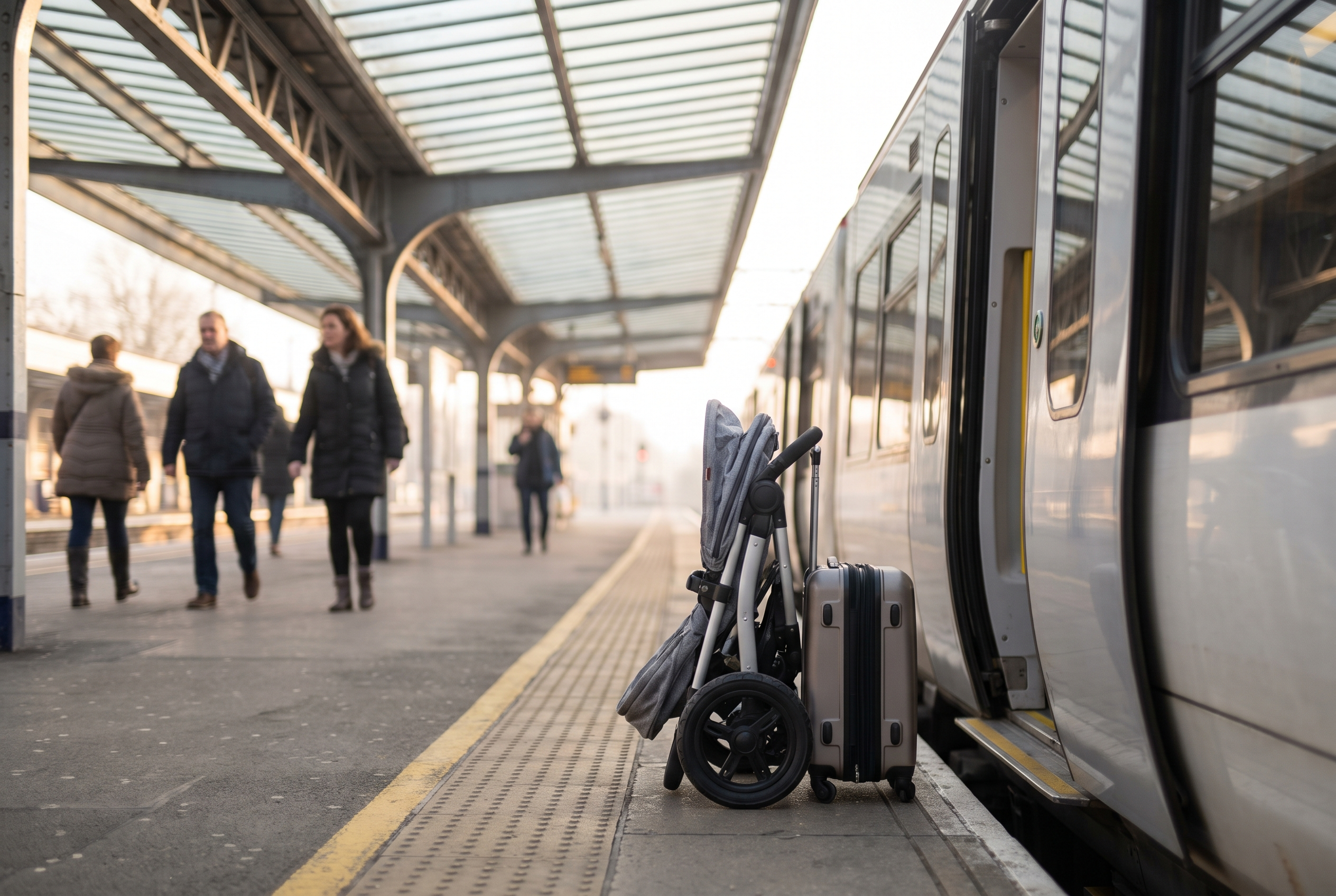
If you have never needed a ramp, it is easy to underestimate what this changes. Booking assistance means planning your journey around someone else's availability. It means arriving early. It means the small, wearying uncertainty of not knowing whether the person with the ramp will be there when the train pulls in, and what happens if they are not. People miss connections over it. Some people stop travelling by train because of it. Level boarding removes the need for the ramp, and with it the need for the booking, the wait and the uncertainty. That is not a convenience upgrade. It is the difference between a journey you can decide to make this morning and a journey you have to arrange. The group it helps is also much wider than wheelchair users. The Department for Transport names older passengers, parents with pushchairs and people carrying luggage. Anyone who has tried to lift a buggy onto a train with a toddler in one hand knows the problem. So does anyone with a knee that no longer likes steps. There is a design principle underneath this that is worth naming. Things built for people with the greatest difficulty tend to work better for everyone. Dropped kerbs were for wheelchairs. Everybody with a suitcase uses them.
What the evidence actually says
This is a genuine commitment with genuine limits, and both halves deserve to be stated. The commitment applies to new trains. It does not retrofit the existing fleet. Britain's trains last a long time, often thirty years or more, so the vehicles running on most lines today will still be running for a good while yet. This is a change that arrives gradually, as fleets are replaced. The wording is also careful. The government says new trains "will aim to have" level boarding, and that it will be a baseline expectation "wherever possible". That is not the same as a guarantee on every route. There is a good engineering reason for the caveat. Level boarding depends on the train and the platform matching. Britain's platforms are not all the same height, and many stations are old, curved, or on gradients. A train designed for a standard Network Rail platform height will board level at a standard platform, and not necessarily at an unusual one. That is precisely why the Access for All money for step-free access matters alongside it. Getting onto the train is one problem. Getting onto the platform is a different one, and a station with steps and no lift is still inaccessible however good the train is. On cost, the government's claim that level boarding will not add significant expense is plausible and supported by example. Greater Anglia and Merseyrail already do it. Designing for it from the outset is far cheaper than modifying later. That is a real argument, not a hopeful one.
Practical advice
Nothing changes on your next journey, so the existing tools still matter. - Passenger Assist is free and available across the network. You can book help through your train operator, and assistance can now be arranged at short notice rather than only days ahead. Booking still makes it more reliable. - Check station accessibility before you travel, not when you arrive. Operators publish which stations have step-free access to each platform, and lifts do break. - If you use a wheelchair or mobility scooter, check the dimensions your operator accepts, and allow extra time for your first journey on an unfamiliar route. - If assistance fails to arrive, report it. Train operators must have a complaints process, and accessibility failures are tracked. A complaint that is never made cannot change anything. - If you are travelling with a pushchair, boarding at the door nearest the wheelchair space is usually easiest, as that is where the floor is lowest. If you want to follow the change, watch for new fleet announcements on your local route. That is when level boarding will actually reach you.
What to know
The Transport Secretary confirmed on 29 September 2026 that new Great British Railways trains will aim to have unassisted level boarding between train and platform as standard, removing the need for a ramp and for booked assistance. It forms part of the rolling stock and infrastructure strategy announced on 28 September, which brings trains, track, depots and maintenance under one publicly owned body. The government says the change is not expected to add significant cost in most cases, because trains will be designed for standard Network Rail platform heights from the outset, as already seen on Greater Anglia and Merseyrail and on new Alstom trains for the Transpennine Route Upgrade. The commitment covers new trains only, and is expressed as an aim wherever possible, because platform heights vary. Almost £280 million of Access for All funding for step-free station access has been announced this year, with over 30 schemes underway across England, Scotland and Wales. Sources: Department for Transport, "Don't mind the gap: level boarding commitment for new trains", 29 September 2026, https://www.gov.uk/government/news/dont-mind-the-gap-level-boarding-commitment-for-new-trains. Department for Transport and DfT Operator Limited, "Government explores buying trains over leasing in new rail strategy", 28 September 2026, https://www.gov.uk/government/news/government-explores-buying-trains-over-leasing-in-new-rail-strategy. This article is for general information. For advice about travelling with a disability or mobility need, contact your train operator's Passenger Assist service, This article does not replace advice from a doctor, pharmacist or other qualified healthcare professional about any medical question relating to travel.
Related articles

Twenty separate flare-ups: the French mosquito season nobody expected
France has had an unusual mosquito season, and the figures are now in. Santé publique France, the country's public health agency, published its enhanced survei…
Fever, rash and sore joints: a northern virus turns up in Germany
The European Centre for Disease Prevention and Control has reported something that had not happened before: Germany's first known case of symptomatic Sindbis vi…
259 of them in one county: the dengue you can catch in Florida
On 12 October 2026, the UK's National Travel Health Network and Centre – the service behind TravelHealthPro – added dengue in the United States to its outbreak…