
A chip the size of a stamp, and software that spots a tumour cell among billions
What happened
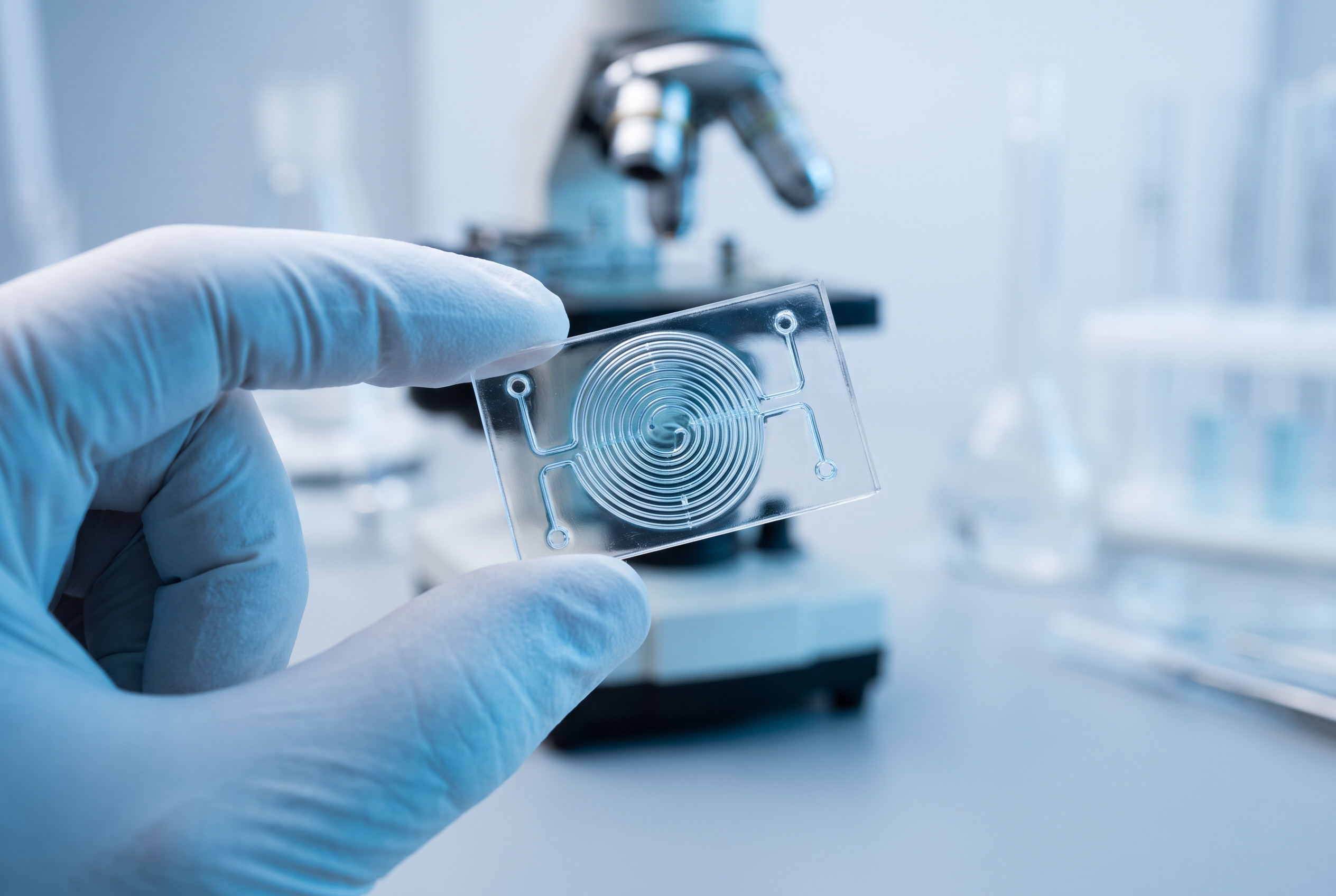
On 29 September 2026, researchers in China published a study describing a new way to find cancer cells circulating in a sample of blood. The work comes from Taiyuan University of Technology and Shanxi Bethune Hospital, and was published in the journal Biomedical Analysis under the title "Label-free Enrichment and Identification of Circulating Tumor Cells Integrating Inertial Microfluidics and Deep Learning". The team built a two-part system. The first part is a small chip with a spiral channel cut into it, narrowing and widening along its length. Blood is pushed through. Because larger and smaller cells behave differently as they travel round the bends, the cells separate by size. Tumour cells, which tend to be about 12 to 25 micrometres across, are pushed one way. Ordinary blood cells, roughly 6 to 12 micrometres, go another. The second part is software. A deep learning model called YOLOv8 looks at ordinary microscope images of what comes out, and picks out the tumour cells. The word that matters is "label-free". Most current methods need a chemical tag, usually a fluorescent marker or an antibody, to make tumour cells visible. This approach uses shape, size and image recognition instead.
Why this matters
Circulating tumour cells are cells that have broken away from a tumour and are travelling in the bloodstream. Finding them can tell doctors things a scan cannot: whether a cancer is spreading, whether treatment is working, and sometimes what kind of cancer it is. The trouble is how rare they are. The researchers describe the scale of the problem as finding somewhere between one and ten tumour cells among billions of blood cells. It is a needle in a haystack, where the haystack is also made of needles. Current methods work, but they are fiddly and expensive. Antibody-based capture only finds cells carrying the marker you chose to look for, so it can miss cancer cells that have changed their surface proteins. Fluorescent labelling adds chemicals, cost and steps, and can damage the cells you want to study afterwards. A label-free method would be cheaper, simpler and gentler. Crucially, cells that have not been chemically tagged are still usable for further testing, such as growing them in the laboratory or reading their genes. That is the prize: a blood test that tracks a cancer over time, instead of waiting for the next scan.
What the evidence actually says
The numbers reported are encouraging, and the limits are clearly stated. Both deserve equal weight. On the chip, the team reports recovering 89.2% of the target tumour cells, give or take 3.1%, while removing 86.9% of white blood cells, give or take 1.4%. The proportion of the sample that was tumour cells rose from 9% to 38% after the chip did its work. On the software, the deep learning model reached 96.0% accuracy, with 94.6% precision and recall, and 95.4% specificity. Now the limits, which the researchers set out themselves. This is a proof-of-concept study. The testing used MCF-7 cells, a laboratory breast cancer cell line, spiked into artificial samples. It has not been tested on blood from actual patients. That distinction is large. Real blood from a real person is messier, more variable and far harder than a prepared sample. Many technologies that perform beautifully on spiked samples struggle in clinic. The two halves of the system are also not yet joined up. The separation chip and the recognition software are not integrated into a single automated machine. And only one cancer cell type was used. Whether the size-based separation works as well for other tumours, whose cells may be smaller or differently shaped, is an open question. The lead researchers, Professor Xiaochun Li and Dr Weizhi Liu at Taiyuan University of Technology, with Director Lizhong Zhang at Shanxi Bethune Hospital and first author Junyi Ouyang, describe the aim as providing "a simpler and more flexible approach for label-free CTC analysis and future downstream applications".
Practical advice
Nothing here changes any patient's care today, and it will not for some years. But there are a few sensible things to take from it. If you or someone close to you is living with cancer, it is worth knowing that "liquid biopsy" is a genuine and fast-moving field, and it is a reasonable thing to ask your oncology team about. Some blood-based tests are already in use for specific cancers in the UK. Your specialist can tell you whether any apply to your situation. When you read about a cancer breakthrough, three questions sort most of the noise from the signal. Was it tested on patients, or on laboratory samples? How many? And is it one cancer type or several? On that test, this study is early-stage work: well-conducted, honestly reported, and a long way from a clinic. Finally, be wary of anyone selling a direct-to-consumer cancer blood test on the strength of research like this. If a test is proven and appropriate for you, it will come through your NHS team.
What to know
Researchers at Taiyuan University of Technology and Shanxi Bethune Hospital have combined a spiral microfluidic chip with a deep learning image recognition model to separate and identify circulating tumour cells without chemical labels. In laboratory testing, the chip recovered 89.2% of target tumour cells and removed 86.9% of white blood cells, raising tumour cell content from 9% to 38%. The software identified tumour cells with 96.0% accuracy. The study is a proof of concept. It used a laboratory breast cancer cell line in artificial samples rather than patient blood, the two components are not yet integrated into one system, and other tumour types have not been tested. It is a promising step, not a test you can ask for. Sources: Junyi Ouyang and colleagues, "Label-free Enrichment and Identification of Circulating Tumor Cells Integrating Inertial Microfluidics and Deep Learning", Biomedical Analysis, 29 September 2026, https://doi.org/10.1016/j.bioana.2026.08.004. EurekAlert! (AAAS), "A tiny chip and AI team up to find hidden tumor cells in blood", 29 September 2026, https://www.eurekalert.org/news-releases/1145817. This article is for general information and does not replace advice from a doctor, oncologist or other qualified healthcare professional. If you have questions about cancer testing or treatment, speak to your clinical team.
Related articles

Four months early: 3,880 rural premises and an £8.2 million contract
On 13 October 2026, the government announced that a rural broadband project in North Oxfordshire had finished four months ahead of schedule. The work connected…
First hearing from a police cell: £17.4 million and four force areas
On 12 October 2026, the Ministry of Justice published the government's response to Lord Leveson's review of the criminal courts. The review made 180 recommendat…
Over 1,000 weak spots found, and a minister's message to AI firms
On Monday 12 October 2026, the UK government set out a package of measures aimed at protecting the country from increasingly powerful artificial intelligence.…