
Thirteen years of stakes in the ice: what one Greenland ice cap has lost
What happened
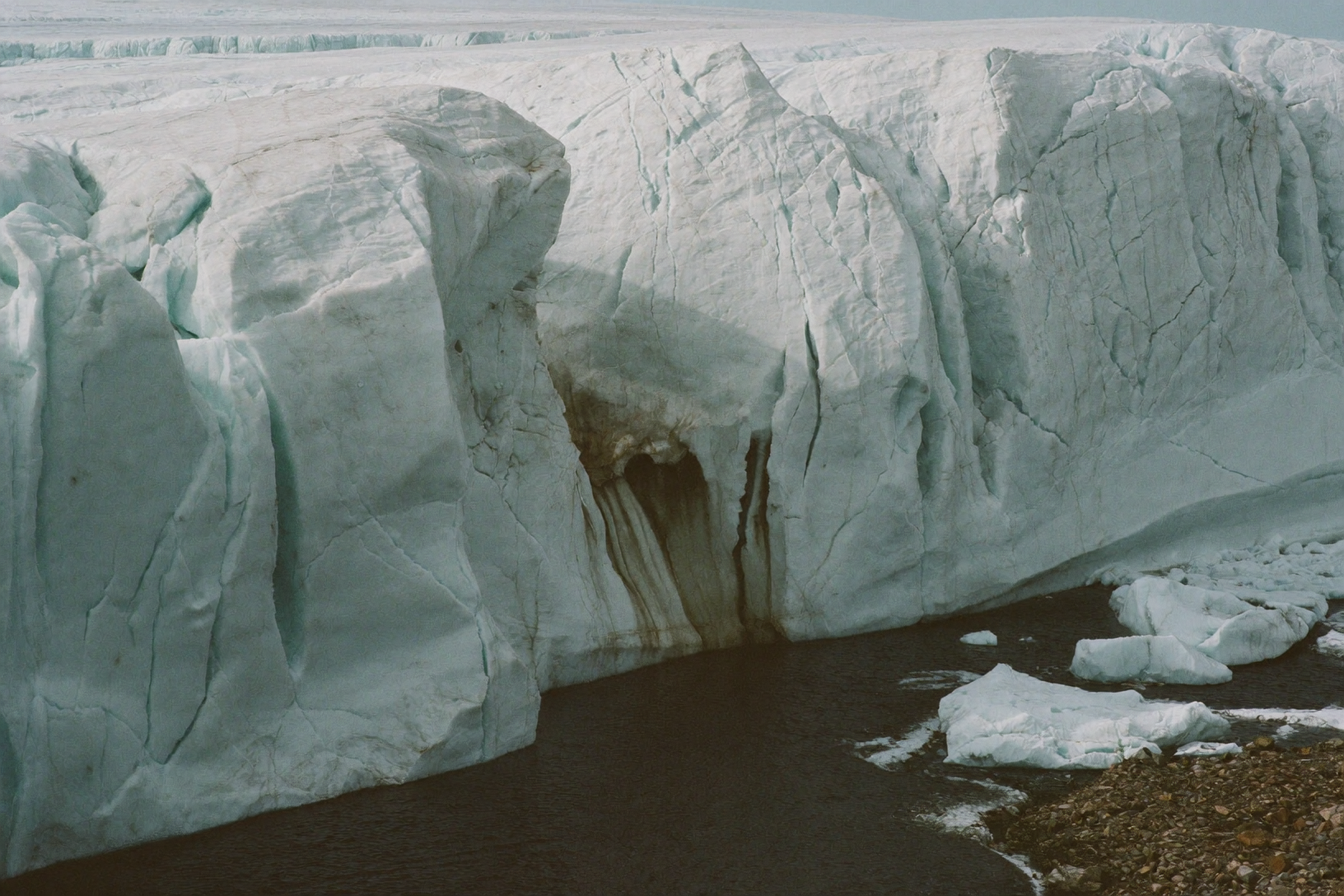
In north-west Greenland, near the town of Qaanaaq, there is an ice cap. It is not one of the famous ones. It is a modest dome of ice, of the kind found all around Greenland's edges. Since 2012, a team from Hokkaido University in Japan has been going back to it, year after year, and measuring it by hand. They drilled aluminium poles into the ice and came back to see how much of each pole was sticking out. They set up GPS devices to track how fast the ice was sliding. They measured surface height at 280 separate locations. They recorded air temperatures and snow conditions. On 18 September 2026, they published what thirteen years of that work adds up to, in the Journal of Glaciology. Between 2012 and 2025, the ice cap lost enough ice to cover its own surface with about eight metres of water. The Qaanaaq Glacier, which flows out of it, dropped by an average of 8.7 metres. The lead researcher quoted on the work is Shin Sugiyama.
Why this matters
Most reporting on Greenland is about the giant ice sheet in the middle. That is fair enough, because it holds the most ice. But the small ice caps and glaciers around the edges matter more than their size suggests. They are lower down, so they sit in warmer air. They react faster. And there are a great many of them. They also sit right next to where people live. Qaanaaq is a real town with real residents, and meltwater rivers, unstable ground and changing coastlines are part of daily life there, not an abstraction. There is a second reason this particular study is valuable. Satellites can measure ice from space, and they cover far more ground than any field team. But they cannot easily tell you why the ice is changing. Poles in the ice and GPS units on the surface can.
What the evidence actually says
Eight metres of water spread across the ice cap's surface is the headline figure for the whole thirteen years. On the glacier itself, the surface fell by an average of 8.7 metres. Two findings go beyond the totals. First, the loss sped up in the later years of the study, and the speeding up was concentrated at lower elevations - the warmer, thinner end of the glacier. Second, and more surprising, about half of that extra loss at low elevations was not caused by melting at the surface. It came from changes in how the ice was moving. As Sugiyama put it: "About half of the increase in ice loss in the lower part of the glacier was linked to changes in ice movement." That is a genuinely useful distinction. Surface melt is fairly straightforward to model from air temperature. Ice flow is not. If flow changes are doing half the work at this ice cap, models that concentrate on melting alone may be underestimating what happens at others. The limits are clear enough. This is one ice cap. Thirteen years is a good run for this kind of fieldwork but short in glacial terms. And measurements at 280 points, while detailed, still involve estimating what happens between them. What gives the study its weight is not statistical power. It is that someone kept going back.
Practical advice
There is no action for anyone to take from a single glacier study, and it would be dishonest to suggest otherwise. But a few things are worth carrying away. When you read about ice loss, look at what is being measured. 'Surface lowering' and 'mass loss' are different things, and a figure like eight metres means very little without knowing what it is eight metres of. This study was clear about it, and clarity is a good sign in any research you read. If you want reliable information on this subject rather than headlines, the Met Office and the UK Centre for Ecology and Hydrology both publish plain-English summaries, and the Journal of Glaciology abstracts are free to read. For anyone thinking about the health side of a warming climate, the practical UK version is mostly about heat. Older people, young children and people with heart, lung or kidney conditions, or who take certain medicines, are more affected by hot weather. The UK Health Security Agency publishes heat health alerts, and it is worth knowing whether anyone in your family falls into those groups before next summer rather than during it. If you take regular medication, ask your pharmacist how heat affects it. Some medicines need to be stored below 25 degrees, and some make it harder for the body to cope with heat.
What to know
A team from Hokkaido University has measured the Qaanaaq ice cap in north-west Greenland every year since 2012, using poles drilled into the ice and GPS units on the surface. Over thirteen years, it lost the equivalent of about eight metres of water spread across its surface. The glacier flowing from it dropped by an average of 8.7 metres. Losses accelerated in later years, particularly lower down. About half of that extra low-elevation loss came from the ice moving differently, rather than from melting at the surface. That is the finding most likely to change how other glaciers are modelled. Small ice caps like this one are often overlooked next to Greenland's main ice sheet. They respond faster, there are many of them, and they are the ones nearest to where people actually live. Sources: Journal of Glaciology, study of the Qaanaaq Ice Cap, north-west Greenland, 2012-2025, published 18 September 2026, https://www.cambridge.org/core/journals/journal-of-glaciology | Phys.org, "Greenland's Qaanaaq Ice Cap has lost enough ice to produce a layer of water about 8 meters deep", 18 September 2026, https://phys.org/news/2026-09-greenland-qaanaaq-ice-cap-lost.html | Hokkaido University, Institute of Low Temperature Science, https://www.lowtem.hokudai.ac.jp/en/ This article is for general information and does not replace advice from a doctor, pharmacist or other qualified healthcare professional.
Related articles

Like an EPC, but for flooding: the rating coming to English homes
On Tuesday 13 October 2026, the government and Flood Re announced plans for a new document for homes in England: a Flood Performance Certificate. Flood Re is t…
From 31,101 to 6,277: what 'backlog cleared' actually means
On 12 October 2026, the Home Office announced that it had cleared the backlog of modern slavery cases waiting for a final decision. The system in question is t…
63 days, 41 days, 21 days: the new council tax clock explained
On 12 October 2026, the Ministry of Housing, Communities and Local Government published its response to a consultation on council tax enforcement in England. It…