
Fewer fish, but bigger ones: what a decade-old restored reef looks like
What happened
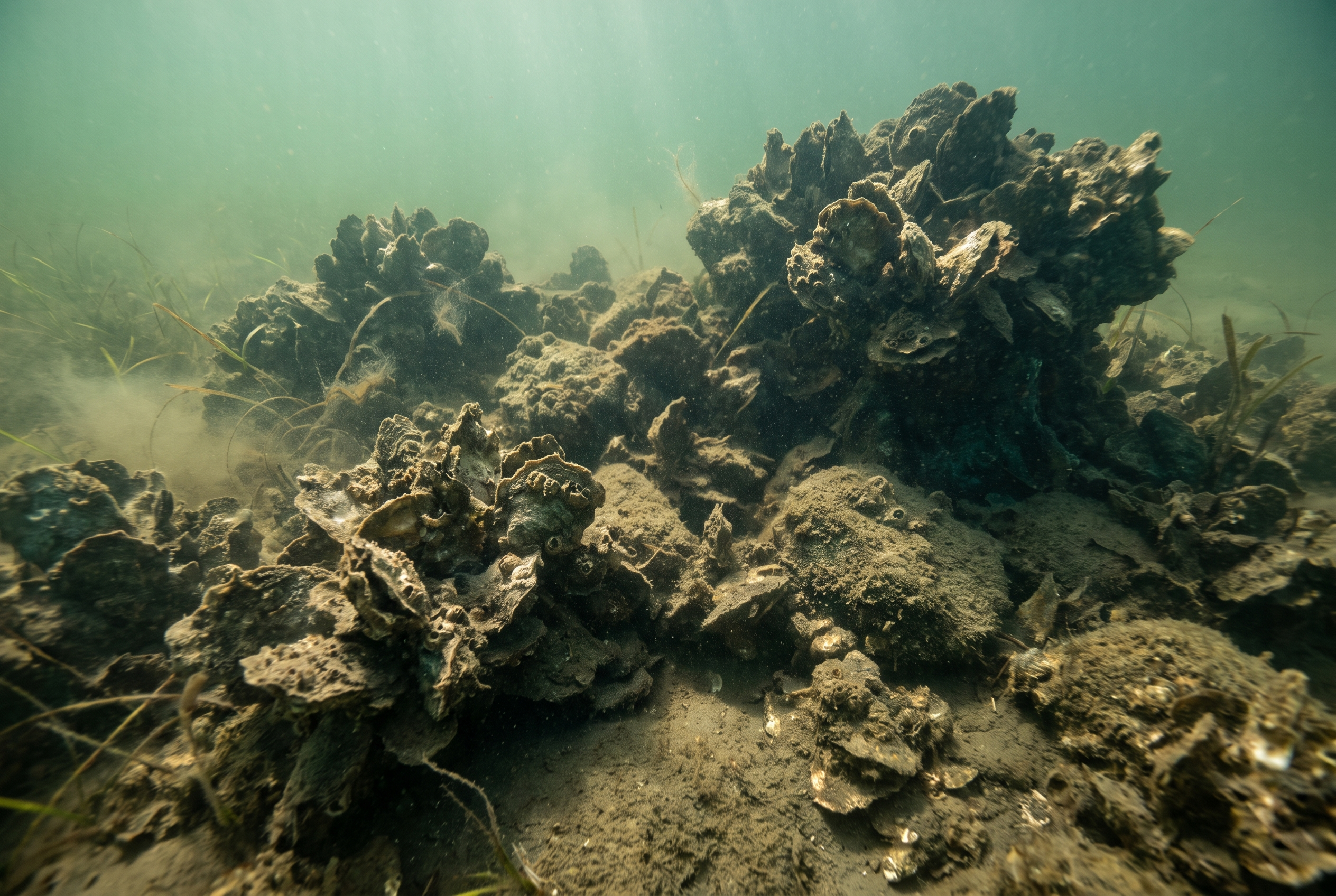
On 16 September 2026, the journal Ecosphere published a study asking a question that conservation projects are rarely around long enough to answer: does restoration still work a decade later? Scientists from the University of Maryland Baltimore County, the Smithsonian Environmental Research Center and NOAA looked at Harris Creek, on Maryland's Eastern Shore in the United States. It is one of the largest oyster reef restoration projects anywhere. Rather than checking shortly after the work was done, as most studies do, they came back 6 to 10 years afterwards. The lead author was Allison Tracy. Studying anything in an estuary is awkward, because the water is murky and you often cannot see much. The team got around this by combining underwater video with high-resolution imaging sonar, which builds a picture using sound rather than light. That let them survey roughly 1.4 square kilometres of restored reef and watch free-swimming animals, including fish and turtles. They found the reefs were still there and still working. Oyster cover remained high years after construction, and the reefs were self-sustaining rather than needing to be rebuilt. The finding about fish was more surprising. Restored reefs supported fewer fish in total - but noticeably larger ones. The greatest numbers of fish over 30 centimetres were found on reefs restored using stone as a base with young oysters added on top, which also had the most complex structure.
Why this matters
Oysters are not just something to eat. A reef of them is a living structure: hard, lumpy, full of crevices, and constantly filtering water. That structure does several jobs at once. It gives small creatures somewhere to hide and bigger ones somewhere to hunt. It slows waves before they reach the shore. And the oysters themselves filter enormous volumes of water, which helps clarity. Britain used to have a great deal of this. Native oyster beds once covered large areas of our estuaries and coast, and oysters were cheap, everyday food. Overfishing, disease and pollution reduced native oyster beds to a small fraction of their former extent, and restoration projects are now under way in places including the Solent, the Firth of Forth, Essex and the Humber. Those projects face the same question this study asked: will it still be there in ten years, or does it quietly fall apart once the funding and the attention move on? The answer here - that the reefs persisted and stayed self-sustaining - is genuinely encouraging for anyone trying to do the same thing on this side of the Atlantic.
What the evidence actually says
The 'fewer fish but bigger fish' result deserves unpacking, because it is easy to read as bad news and it probably is not. A complex three-dimensional reef shifts the balance of who lives there. Instead of clouds of small schooling fish drifting over flat bottom, you get larger, resident, bottom-dwelling species that stay put and use the structure. Fewer individuals, more mass, and a more settled community. For most measures of ecosystem health, that is a sign of maturity rather than decline. The method is a real strength. Underwater video alone is nearly useless in murky estuary water, so a lot of what we think we know about these habitats comes from methods that miss things. Adding imaging sonar lets you count animals you simply cannot see, and it covers more ground. The main limitation is that this is one system. Harris Creek is a specific place with specific conditions, and Chesapeake Bay oysters are not the same species as Britain's native oyster. Restoration techniques that work in Maryland will not automatically work in the Solent, and the study cannot tell us they will. The finding about technique is worth noting, though. Reefs built with stone substrate plus young oysters did best. That is a practical, transferable detail rather than a vague conclusion, and it is the kind of thing restoration teams elsewhere can test. One more honest note: this study measured habitat and the animals using it. It did not measure water quality improvement or coastal protection directly, which are often the benefits used to justify funding.
Practical advice
This is an American study about an American estuary, so the direct actions are limited. But there are some real ones. If you live near the coast, find out whether there is a restoration project nearby. The Solent, Essex, the Humber, the Firth of Forth and parts of Wales all have native oyster work under way, and most welcome volunteers or supporters. Some involve simple, satisfying jobs like collecting and cleaning shell. Return your oyster shells if you eat them. Several restoration projects run shell recycling schemes with local restaurants, because clean old shell is the best surface for young oysters to settle on. Shell that goes in a bin is wasted. Buy shellfish thoughtfully. Farmed mussels and oysters are among the lower-impact animal foods there are - they need no feed, no fresh water and no land, and they filter the water they grow in. Be careful about eating shellfish you gather yourself. Oysters and mussels filter water, which means they concentrate whatever is in it, including bacteria and toxins from algal blooms. Commercially sold shellfish comes from classified, monitored beds. Wild-gathered shellfish does not, and shellfish poisoning is serious. If you are pregnant, elderly, immunosuppressed or have liver disease, avoid raw shellfish altogether. And support clean water campaigns locally. Oyster restoration and sewage overflow are the same issue seen from two ends.
What to know
Researchers returned to a large restored oyster reef system in Maryland 6 to 10 years after the work was done, and used sonar alongside underwater video to see through murky water. The reefs were still there, still covered in oysters, and self-sustaining. They held fewer fish in total, but markedly bigger ones - most of all where reefs had been built on stone with young oysters added, which produced the most complex structure. That points to a more mature habitat rather than a failing one. It is one estuary, and a different oyster species from Britain's native one, so it does not settle how UK projects will fare. But for restoration work in the Solent, Essex, the Humber and the Forth, evidence that reefs last a decade without maintenance is exactly the evidence that has been missing. If you eat oysters, ask whether your restaurant recycles its shells. It is a small thing that restoration projects genuinely need. Sources: Ecosphere (Wiley/Ecological Society of America), Allison Tracy et al., oyster reef restoration outcomes at Harris Creek, 16 September 2026, DOI 10.1002/ecs2.70750, https://doi.org/10.1002/ecs2.70750. Phys.org, 'Long-term oyster reef restoration shows clear success in murky waters', 17 September 2026, https://phys.org/news/2026-09-term-oyster-reef-success-murky.html. Smithsonian Environmental Research Center, https://serc.si.edu/. This article is for general information and does not replace advice from a doctor, pharmacist or other qualified healthcare professional.
Related articles
England needs 120% of normal rainfall over seven months to leave drought behind
The government, the Environment Agency and water company bosses met on 16 September 2026 to discuss how England gets out of drought. The headline number from t…
Microplastics were in every one of 227 farm fields tested across Europe
A five-year research project has found microplastics in the soil of every single agricultural field it tested. The EU-funded project tested 227 farm fields acr…
A wild cat smaller than your pet has just been named for the first time in a century
A small wild cat living in the cloud forests of Bolivia has been confirmed as a species nobody had formally described before. This is rarer than it sounds. It…