
The tile that never repeats itself is now being used to twist light
What happened
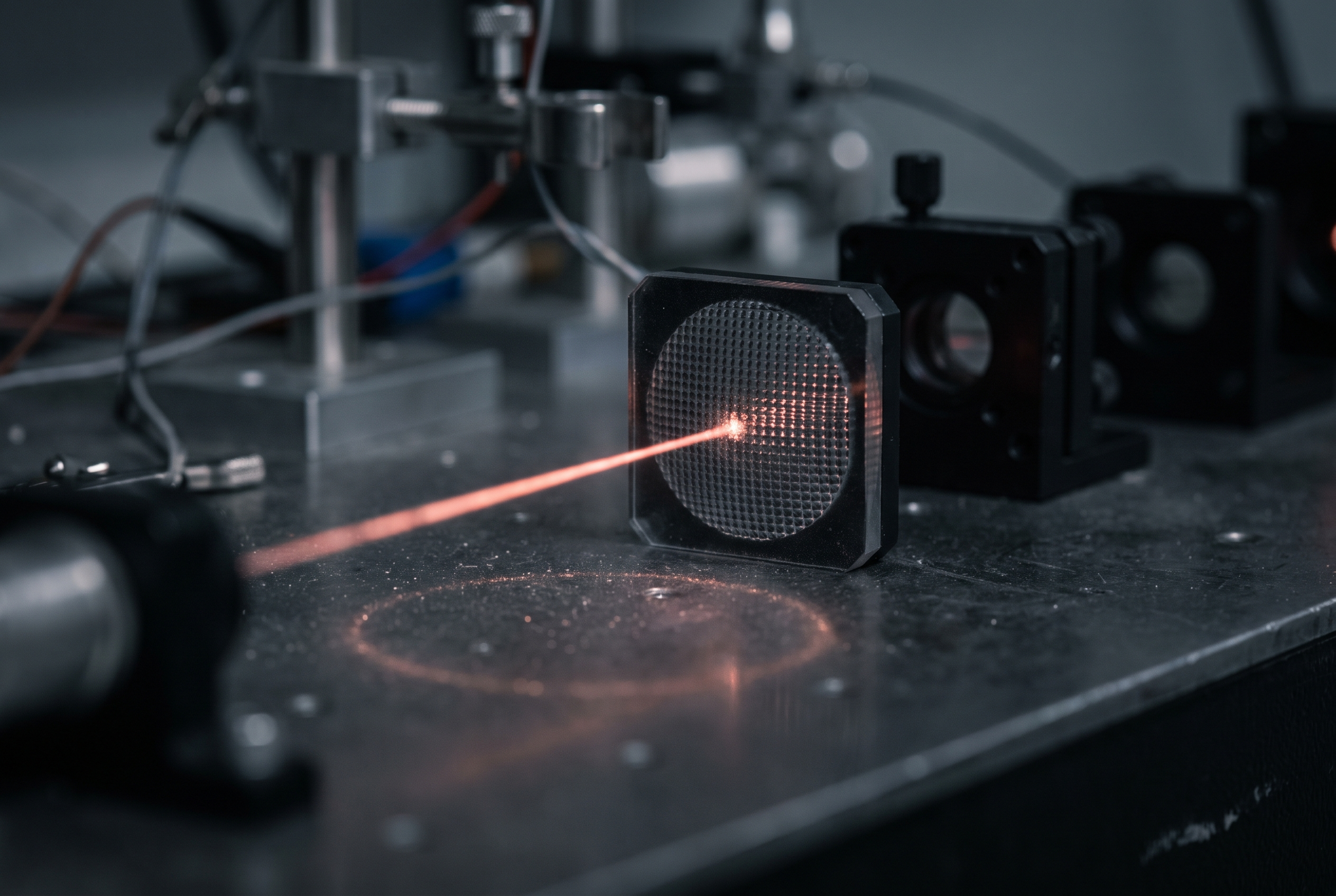
On 15 September 2026, the journal Nature Communications published a study that connects a famous maths puzzle to a very practical question about light. The puzzle is known as the einstein problem. Confusingly, it has nothing to do with Albert Einstein. 'Ein Stein' is German for 'one stone', and the question was this: is there a single tile shape that can cover a flat surface forever without the pattern ever repeating? For decades nobody knew. Then, in 2023, an amateur mathematician named David Smith found one. It is a slightly lopsided thirteen-sided shape, and it became known as the 'hat'. You can tile a floor with it endlessly, and the pattern never repeats, no matter how far you go. That was a lovely piece of pure maths. This new work asks what happens if you shrink the hat down to a scale smaller than a wavelength of light, and shine a laser at it. A team at the Institute of Industrial Science at the University of Tokyo built nanoscale structures based on the Smith hat pattern and did exactly that. The light came out in a distinctive pinwheel shape. More interestingly, the pattern was chiral, which means it has a handedness: it is different from its own mirror image, the way your left hand is different from your right. And how the light behaved depended on which direction it arrived from and how it was polarised.
Why this matters
Chirality sounds abstract but it is everywhere. Many molecules come in left-handed and right-handed versions, and the two can behave completely differently in the body. A great deal of chemistry and pharmacy is about telling them apart. One of the main ways scientists do that is by shining specially twisted light through a sample and seeing how it responds. Better tools for controlling that twist mean better tools for detection. There is also a broader point about how these structures work. Normally, if you want to do something clever with light, you build a repeating pattern - a grating, a crystal, a regular grid. Repeating patterns have rules, and those rules limit what you can do. A pattern that never repeats does not have those rules in the same way. It has order, but not repetition. That combination is unusual, and the Tokyo team's point is that it opens up behaviours a regular grid simply cannot produce. The fact that the diffraction patterns themselves became chiral, because the structure has no mirror symmetry, is the specific finding here.
What the evidence actually says
This is a physics result, and it deserves to be read as one. What the team demonstrated is real and measured: they built the structures, shone light at them, and recorded pinwheel diffraction patterns whose behaviour depended on direction and polarisation. That is a solid observation, published in a well-regarded peer-reviewed journal. What it is not is a device. There is no sensor, no chip, no product. The paper describes potential applications in 'controlling light, polarisation, and advanced optical devices', and that word 'potential' is doing real work. The gap between an interesting optical effect in a lab and something in a hospital or a phone is usually a decade or more, and most such effects never make that journey. That is not a criticism. It is how physics works. Someone has to find the effect before anyone can use it. It is also worth being clear about what the hat tile is and is not. It is a genuine mathematical breakthrough from 2023, confirmed and celebrated by mathematicians. Using its pattern in optics is a natural next step that several groups have been circling. This is an early entry in that line of work, not the final word. If you see this story described as 'Einstein's shape' or as having anything to do with relativity, that is a misunderstanding of the name.
Practical advice
There is nothing to buy or do here. But there are a couple of genuinely useful takeaways. If you enjoy maths, the hat tile is worth ten minutes of your time. It is one of the rare modern breakthroughs you can actually see and understand without any training. Printable versions are freely available, and children often find it fascinating that a shape can cover a floor forever without ever repeating. It is a good reminder that mathematics is not a finished subject. It is also a nice story about who does science. David Smith was a retired print technician and hobbyist, not a professor. He found the shape by playing with cut-out tiles at his kitchen table, then worked with academic mathematicians to prove it. Three years later, physicists in Tokyo are shining lasers at it. If you read about optical or 'quantum' health devices being sold to consumers, treat them with caution. Genuine advances like this one take years to reach any real application, and they arrive through regulated medical devices, not through gadgets sold online. The MHRA regulates medical devices in the UK, and anything making a medical claim should be registered.
What to know
In 2023 an amateur mathematician found the 'hat', a single tile that covers a surface forever without the pattern repeating, solving a long-standing puzzle. On 15 September 2026, researchers at the University of Tokyo published work in Nature Communications showing that nanoscale structures built on that pattern scatter laser light into pinwheel shapes, and that those patterns are chiral - they differ from their mirror image - because the structure has no mirror symmetry. This is early-stage physics with possible future uses in controlling light and polarisation. There is no device and no product yet. The nicest part of the story may be the chain itself: a hobbyist with paper tiles, a proof, and then a laser lab on the other side of the world. Sources: Nature Communications (Springer Nature), study from the Institute of Industrial Science, University of Tokyo, on chiral diffraction from aperiodic Smith hat nanostructures, 15 September 2026, https://www.nature.com/ncomms/. ScienceDaily, 'Einstein Problem Shape Reveals Strange Physics', 15 September 2026, https://www.sciencedaily.com/releases/2026/09/260914102432.htm. University of Tokyo Institute of Industrial Science, https://www.iis.u-tokyo.ac.jp/en/. This article is for general information and does not replace advice from a doctor, pharmacist or other qualified healthcare professional.
Related articles

The first study of the Nepal glacier collapse: what the science found
On 26 August 2026, a massive section of overhanging glacier and rock broke away from Langtang Lirung mountain, on the border between Nepal and Tibet. The piece…
Scientists worked out when black holes 'burp' - and it comes down to one number
Astronomers say they have solved a long-standing puzzle about black holes: when they "burp". Black holes have a reputation as cosmic plugholes that swallow eve…

Half a mouse brain, grown from human cells: what scientists just did, and why
Scientists at Stanford University have created mice whose brains are roughly half human tissue by volume. Here is how. The team first genetically engineered mi…