
Four to six a day: researchers find the wholegrain 'sweet spot' for heart health
What happened
On 15 September 2026, the European Heart Journal published a large review of what wholegrains actually do to the body. The work was led by Dr Helda Tutunchi at Tabriz University of Medical Sciences. Her team gathered 87 randomised controlled trials involving more than 6,500 people, from Asia, Europe, the United States, Canada, Australia and Brazil, and analysed them together. A randomised controlled trial is the strongest single type of nutrition study. People are split into groups by chance, so the groups should be similar in every way except what they are asked to eat. Putting 87 of them together is stronger still. The headline finding was a range rather than a single number. Benefits started appearing at around 30 to 40 grams of wholegrains a day. But the strongest effects were seen at roughly 60 to 100 grams a day, which the researchers described as four to six servings. Across those trials, eating more wholegrains was linked to small improvements in body weight, waist size, blood pressure, total cholesterol, LDL cholesterol, triglycerides, blood glucose, and a marker of inflammation called interleukin-6. That is a lot of different measurements all nudging the same way, which is part of why the review got attention.
Why this matters
Heart and circulatory disease is still one of the biggest causes of death in the UK. Most of what raises the risk is not dramatic. It is blood pressure a bit too high for a long time, cholesterol a bit too high for a long time, a waistline that creeps up over a decade. That is exactly the kind of risk that food can shift. Wholegrains are one of the least controversial ideas in nutrition. Unlike almost everything else in the field, there is no real argument about whether they are good for you. What has been fuzzier is how many you actually need. 'Eat more wholegrains' is easy to say and hard to act on. This review puts a number on it. Four to six servings a day is something you can picture and plan around. That is the practical value here. It also matters that the review found benefits starting lower down, at 30 to 40 grams. If you currently eat almost no wholegrains, you do not have to leap to six servings to get something out of it. Most of us will not, and that is fine.
What the evidence actually says
Two big caveats deserve to be read carefully, because they change how much weight to put on this. First, the trials were short. On average they ran about eight weeks. Eight weeks tells you what happens to your cholesterol reading. It does not tell you what happens to your heart over twenty years. Those are different questions. Second, and following from that, the review measured risk factors, not events. Nobody in these trials was tracked to see whether they had fewer heart attacks or strokes. Blood pressure and cholesterol are good stand-ins for heart risk, and they are the things doctors treat. But a stand-in is not the real thing. There is a third point the researchers raise: relatively few studies looked at very high intakes, above 140 grams a day. So the review cannot say much about whether eating a great deal more keeps helping, or whether the benefit flattens off. And the improvements, while consistent, were modest. This is not a substitute for blood pressure tablets or statins if you have been prescribed them. It is the kind of change that stacks with everything else. One more honest note: people in food trials know what they are eating. You cannot blind someone to whether their bread is wholemeal. That means other habits can shift alongside, and some of the benefit may come from what the wholegrains displaced rather than the grains themselves.
Qurexa perspective
We deliver groceries as well as prescriptions, so we see what ends up in people's weekly shop. The gap between 'I should eat more wholegrains' and actually having them in the cupboard is usually just planning, not willpower. The useful thing about wholegrains is that they are among the cheapest healthy swaps there is. Porridge oats, wholemeal bread, brown rice, wholewheat pasta and barley are not premium items. In most shops the wholemeal version costs roughly the same as the white one, and oats are one of the cheapest breakfasts you can buy. If you are ordering a shop anyway, it is a swap that costs nothing extra to make. That is worth saying plainly, because a lot of healthy-eating advice quietly assumes a budget that not everyone has.
Practical advice
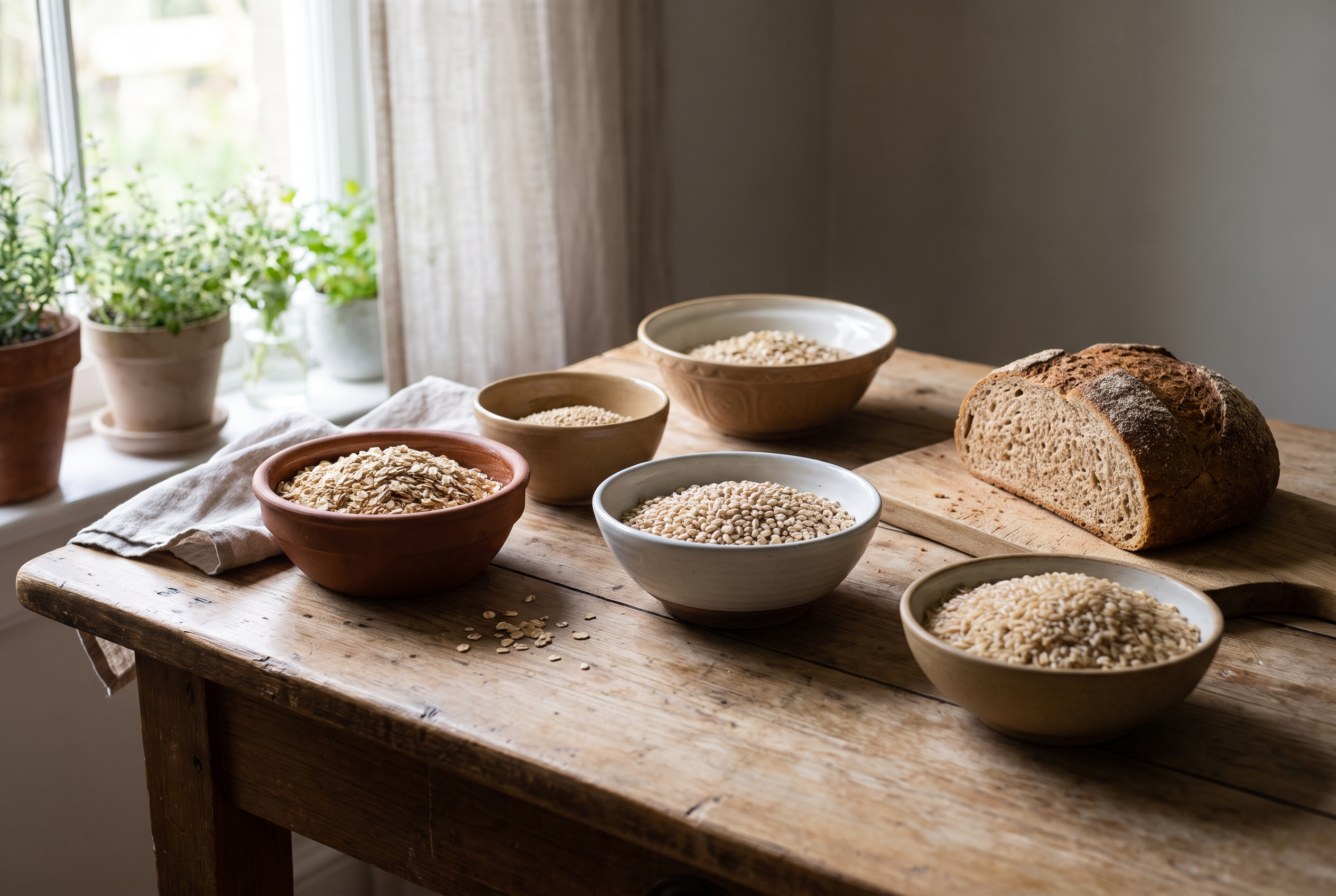
A serving of wholegrains is roughly 16 grams of dry wholegrain. In everyday terms, that is about: One slice of wholemeal bread. Three heaped tablespoons of porridge oats, dry. Half a mug of cooked brown rice or wholewheat pasta. A small bowl of a wholegrain breakfast cereal. So four to six servings a day looks something like: porridge at breakfast, a wholemeal sandwich at lunch, and brown rice or wholewheat pasta with your evening meal. That is it. It is not exotic and it is not expensive. A few tips that make it stick: Swap one thing at a time. Bread is usually the easiest place to start, because it is the thing most people eat every day without thinking. Read the front of the packet with suspicion. 'Multigrain', 'granary' and 'brown' do not mean wholegrain. Look for 'wholemeal', 'wholegrain' or 'whole wheat' as the first ingredient. Go gradually if you are not used to fibre. Jumping straight to six servings can leave you bloated and uncomfortable for a week. Build up over a fortnight and drink a bit more water. If you have coeliac disease, you need gluten-free wholegrains: oats labelled gluten-free, brown rice, quinoa, buckwheat, millet. Ordinary wheat, barley and rye are not an option for you. And if you have a bowel condition such as diverticular disease or IBS, or you are on a restricted diet for a medical reason, check with your GP or a dietitian before increasing fibre sharply.
What to know
A review of 87 randomised trials covering more than 6,500 people, published in the European Heart Journal, found that four to six servings of wholegrains a day - about 60 to 100 grams - was linked to the strongest improvements in weight, waist size, blood pressure, cholesterol, blood sugar and inflammation. Benefits began at around 30 to 40 grams. The trials were short, at about eight weeks on average, and they measured risk factors rather than actual heart attacks and strokes. The improvements were modest. This does not replace medicines you have been prescribed. But it is a rare piece of nutrition advice that is cheap, uncontroversial and easy to picture: porridge, a wholemeal sandwich, brown rice. Start with one swap. Sources: European Heart Journal (Oxford University Press), systematic review and meta-analysis of wholegrain intake and cardiometabolic risk factors led by Helda Tutunchi, 15 September 2026, https://academic.oup.com/eurheartj. ScienceDaily, 'Scientists Find the Whole Grain Sweet Spot for Better Heart Health', 16 September 2026, https://www.sciencedaily.com/releases/2026/09/260915232126.htm. NHS, 'Starchy foods and carbohydrates', https://www.nhs.uk/live-well/eat-well/starchy-foods-and-carbohydrates/. This article is for general information and does not replace advice from a doctor, pharmacist or other qualified healthcare professional.
Related articles

One baby's heartbeat, the wrong screen: a new MHRA warning on labour monitors
The UK's medicines and devices regulator has issued a safety notice about wireless monitors used to track babies' heartbeats during labour. The Medicines and H…

One play specialist for every 22,000 child hospital admissions
A children's charity has found that hospitals in the UK have far too few health play professionals. Health play professionals are trained staff who help childr…

33 studies out of 38 pointed the same way: women are offered less active treatment
Researchers at the University of St Andrews have published a review of global research into how men and women are treated for the same illnesses. The answer wa…