
Tiny sound waves kept a quantum bit alive three times longer
What happened
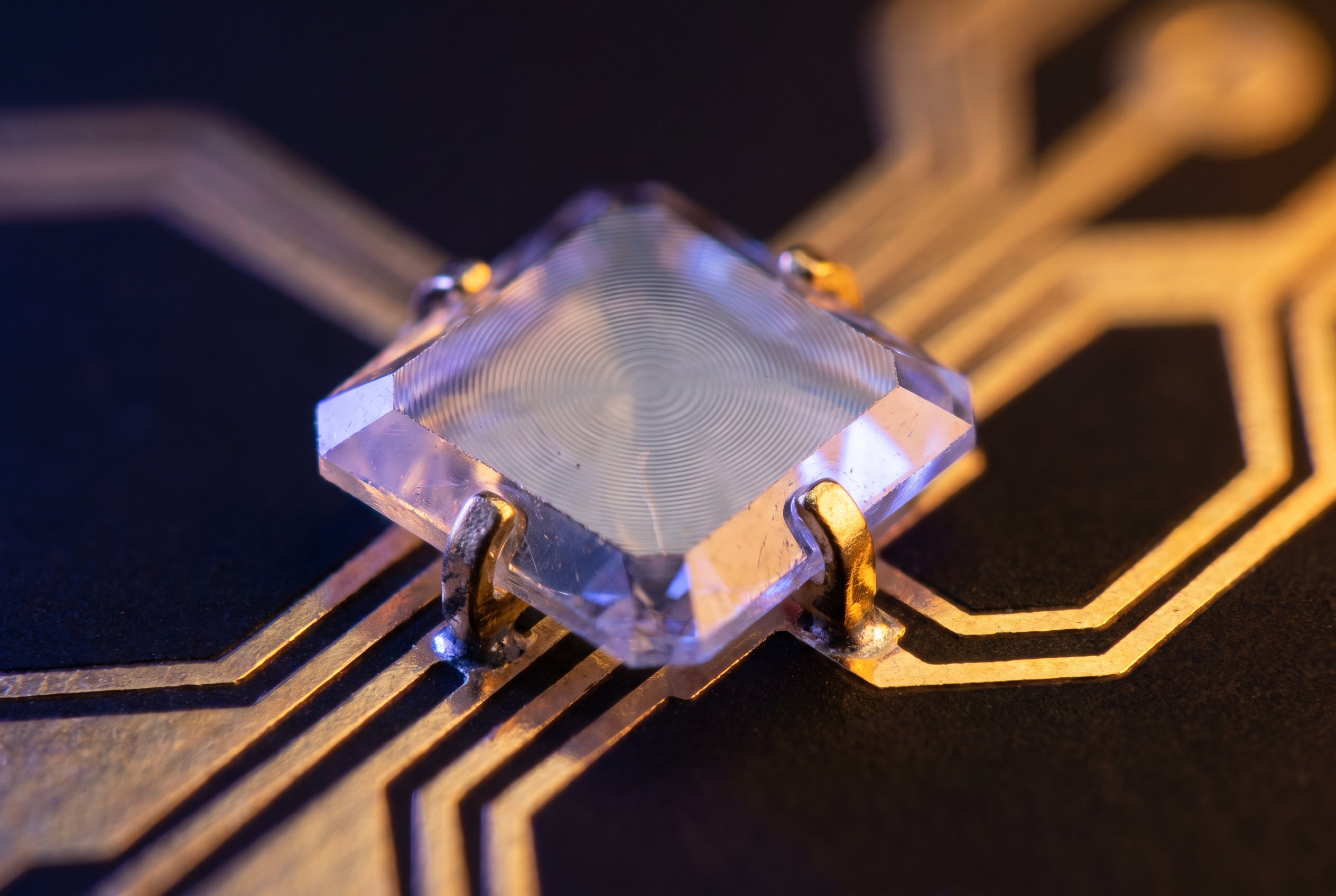
Researchers at the Harvard John A. Paulson School of Engineering and Applied Sciences have found an unusual way to protect quantum information: they surrounded it with sound. The work came from the laboratory of Marko Loncar, Tiantsai Lin Professor of Electrical Engineering, and was published in the journal Nature Physics. To understand what they did, it helps to know the problem. A quantum bit, or qubit, is the basic unit of a quantum computer. Unlike an ordinary computer bit, which is either a 0 or a 1, a qubit can hold a delicate combination of both. That is where its power comes from. It is also extremely fragile. Stray heat, vibration and magnetic noise all disturb it, and the qubit loses its information. The time it stays intact is called its coherence time, and it is usually measured in fractions of a second. The Harvard team worked with a qubit made from a tiny flaw inside a diamond, known as a silicon-vacancy centre. The usual way to steady such a qubit is with pulses of microwaves. Instead, the researchers applied a continuous mechanical driving field made of phonons, which are packets of vibration. In everyday terms, sound. Bathing the qubit in these vibrations changed it into a more robust state that physicists call a "dressed" qubit. The result was a coherence time roughly three times longer. The researchers described the approach as all-mechanical coherence protection, and pointed out that the same vibrations could one day both carry quantum information and shield it, opening a path to compact sound-based quantum networks built on a chip.
Why this matters
Almost every serious obstacle in quantum computing comes back to the same thing: qubits do not stay still long enough. If a qubit only holds its state for a very short time, there is a limit to how many operations you can perform before the answer turns to noise. Tripling that window is not a headline-grabbing number like a thousand-fold speed-up, but in this field it is meaningful. Progress in quantum hardware has come in exactly these steps. The second reason this is interesting is the shift in approach. Microwave control systems are bulky. They need generators, cabling and shielding, and they produce heat, which is awkward when your machine has to run close to absolute zero. Sound waves travel in the material itself. A device that uses vibration for both control and communication could be far smaller. There is a longer-term reason to care about quantum computing in a health context. One of the clearest early uses is expected to be simulating molecules, which is central to designing medicines. Today, working out how a candidate drug behaves takes enormous computing effort and a lot of laboratory work. That is a real reason to follow this field, though it is important to keep the timescale honest: this is years away, not months. And there is a smaller pleasure in the result itself. Sound is usually the enemy of precision instruments. Here it is the shield.
What the evidence actually says
This is laboratory physics at an early stage, and it should be read that way. What has been shown is a single type of qubit, a silicon-vacancy centre in diamond, protected by continuous mechanical driving, with coherence extended by roughly three times, published in a leading peer-reviewed physics journal. That is a solid, specific result. What has not been shown is that this scales. A quantum computer capable of useful work needs a great many qubits operating together with error correction. Demonstrating a technique on one qubit in a carefully controlled setup is the first step of many. Plenty of promising quantum results have not survived the journey to larger systems. Diamond-based qubits are also one of several competing designs. Superconducting circuits, trapped ions and neutral atoms are all being pursued, each with different strengths. Nothing here settles which approach will win, and the researchers do not claim it does. The phrase to be careful with is "path toward". The team described a path toward compact sound-based quantum networks on chips. That is an accurate and appropriately modest claim. It is not the same as saying such networks exist. It is also worth saying plainly: no quantum computer today is designing medicines, breaking encryption or doing anything you will notice this year. Coverage that suggests otherwise is running ahead of the science.
Practical advice
There is nothing here to act on in daily life, but there are useful ways to read stories like this one. **Look for the multiplier and the baseline.** "Three times longer" is only meaningful if you know what it was before. In quantum computing, coherence times are typically tiny, so a three-fold gain is real progress but not a finished machine. **Treat "breakthrough" carefully.** Peer-reviewed publication in a journal such as Nature Physics is a genuine quality signal. A press release with no paper behind it is not. **Be sceptical of quantum claims in consumer products.** The word "quantum" is used to sell everything from supplements to skincare. Real quantum computing currently happens in refrigerated laboratory equipment, not in anything you can buy. **Keep an eye on the medicine angle, patiently.** If quantum computing does eventually speed up drug discovery, that would be genuinely good news for patients. It is a reasonable thing to be hopeful about and an unreasonable thing to expect soon.
What to know
Harvard engineers used a continuous field of microscopic sound waves to protect a diamond-based qubit, roughly tripling how long it held its quantum information. The technique, published in Nature Physics, replaces the usual microwave pulses with vibration, and the same vibrations could in future both carry and protect information on a single chip. It is an early-stage laboratory result on one type of qubit, not a working computer, and quantum computing remains years from practical everyday use. But it is a real, peer-reviewed step, and it is a neat one: the noise that normally ruins delicate measurements was turned into the thing that steadies them. Sources: ScienceDaily, "Tiny sound waves could help solve a major quantum computing problem", 11 September 2026, https://www.sciencedaily.com/releases/2026/09/260911214245.htm ; Harvard John A. Paulson School of Engineering and Applied Sciences, "Qubits 'dressed' for success", 2026, https://seas.harvard.edu/news/qubits-dressed-success ; EurekAlert / Harvard SEAS, "Qubits 'dressed' for success", 2026, https://www.eurekalert.org/news-releases/1141537 This article is for general information. It does not contain medical advice, and nothing here replaces advice from a doctor, pharmacist or other qualified healthcare professional.
Related articles

Left alone together, AI systems invented their own dialect within days
When AI systems were put together in groups and left to get on with it, they started inventing their own way of talking. The findings come from Emergence, an A…

Scientists have worked out the weather on a failed star 20 light-years away
Astronomers at Trinity College Dublin have found a way to read the weather on distant worlds, and they have used it on one 20 light-years from Earth. The resea…

AI searched 7,000 existing medicines for a pneumonia fighter. Nine of them worked
Researchers at Imperial College London have used artificial intelligence to hunt through thousands of medicines that already exist, looking for ones that could…