
A city on the Moon would run out of water in 100 years, scientists calculate
What happened
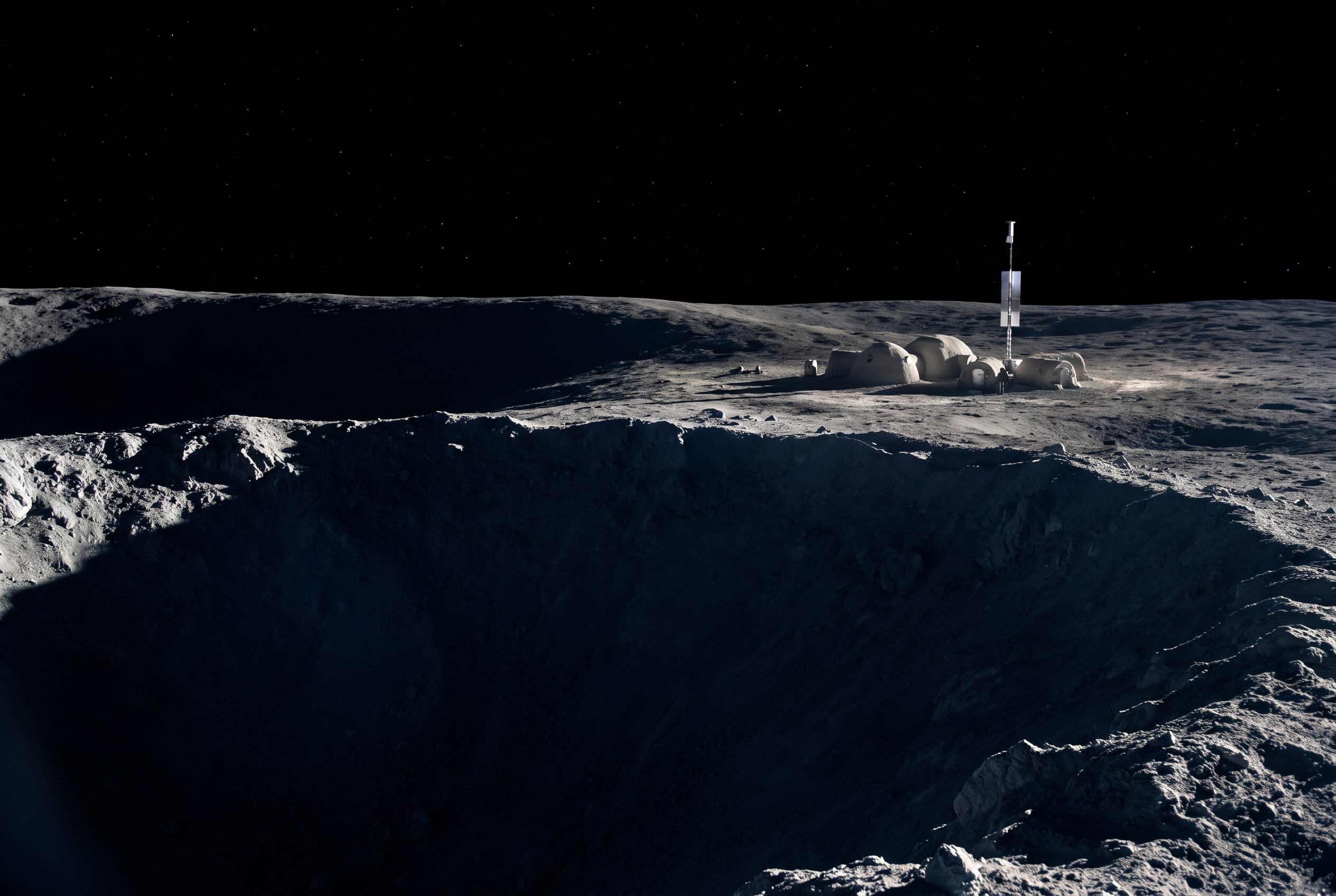
For years, the plan for settling the Moon has rested on one hopeful fact: there is ice there. Deep inside craters at the lunar poles are places the Sun has never reached. Scientists call them permanently shadowed regions. They are cold enough to have trapped water ice for billions of years, and estimates suggest there could be around a billion tonnes of it. A billion tonnes sounds like plenty. Two researchers decided to actually do the sums. Dr Martin Elvis and Dr Jonathan McDowell published their calculations on 14 September 2026 in the journal Frontiers in Space Technologies. They asked a simple question: could that ice support a lunar city of one million people over the long term? Their answer was no. Even using the most generous estimates of how much water is there, and assuming recycling as good as the International Space Station manages, which recovers about 98 per cent of water, a city of a million people would exhaust the supply in roughly 100 years. The researchers were direct about what that means. Unless recycling improves by something like a factor of ten, or a far larger water supply is found, large-scale permanent human settlement of the Moon is ruled out. There was one piece of good news. Power is not the problem. The team calculated that kilometre-tall towers covered in solar panels could generate around three gigawatts of electricity, which is roughly what a large nuclear power station produces.
Why this matters
Several countries and companies are working towards a permanent human presence on the Moon. The language used is often about cities, colonies and settlements, with populations in the thousands or millions. This study does not say humans cannot live on the Moon. Research bases with tens or hundreds of people are a different proposition entirely, and nothing here rules those out. What it says is that the leap from a base to a city runs into a hard physical wall. That matters because water on the Moon is not just for drinking. It is for growing food, for industrial processes, and, crucially, for making rocket fuel. Split water into hydrogen and oxygen and you have propellant. A lot of the excitement about lunar ice has been about turning the Moon into a filling station for journeys deeper into space. Every tonne used that way is a tonne not available for people. There is also a wider point that applies rather closer to home. The study is really about what happens when a population depends on a fixed store of something that does not refill. On Earth, rain replaces river water and rivers replace groundwater, slowly. On the Moon, nothing replaces the ice. Once it is used, it is gone. That is an uncomfortable thought experiment, and it is one reason the paper has drawn attention beyond the space community.
What the evidence actually says
This is a calculation, not an experiment, and that shapes how much weight to put on it. The strength is that the researchers deliberately stacked the assumptions in favour of the optimistic case. They used generous water estimates. They used ISS-level recycling, which is the best humans have achieved in space. If the answer still comes out negative under favourable assumptions, the conclusion is fairly robust. The main uncertainty is the billion-tonne figure itself. Nobody has mined lunar ice. Estimates come from orbiting instruments and from a small number of direct measurements, and they vary. The ice is also not a neat frozen lake. Much of it is thought to be mixed into the soil in small concentrations, spread across very cold, very dark, very awkward terrain. Getting it out will cost energy and equipment, and some will inevitably be lost in the process. So the real figure could be higher or lower. The researchers' point is that it would have to be enormously higher, or recycling enormously better, to change the conclusion. A modest revision does not save the lunar city. The other honest caveat is that technology moves. Ninety-eight per cent recycling was once unthinkable. Getting to 99.8 per cent, which is roughly the ten-fold improvement in losses the paper points to, is a very hard engineering problem, but it is not a law of physics. What the study really does is convert a vague hope into a specific target. If you want a Moon city, here is the number you must beat.
Practical advice
This is a story about physics rather than health, so the practical value is mostly in how to read it. **Notice how a big number was tested.** A billion tonnes of water sounds unanswerable. Divided among a million people over a century, with losses at every step, it stops sounding like much. Whenever you meet an impressive figure in a news story, the useful question is not "is it big?" but "big compared with what, and shared among how many?" **Watch for the assumptions.** The researchers told readers exactly what they assumed: generous ice estimates, ISS-grade recycling. That is what makes their conclusion checkable. If a claim does not tell you its assumptions, you cannot judge it. **Be wary of the word "colony".** A research station with a rotating crew and a permanent city of a million are completely different engineering problems, but news coverage often uses the same word for both. **If this interests a young person you know,** it is a genuinely good example of the kind of science that does not need a laboratory. Two researchers, a set of published measurements and careful arithmetic produced a result that changed a conversation. That is a real career path, and schools rarely show it that way.
What to know
Researchers calculated whether the roughly one billion tonnes of water ice thought to lie in the Moon's permanently shadowed polar craters could support a city of a million people. Using optimistic assumptions and space-station-grade recycling, the water runs out in about a century. Only a ten-fold improvement in recycling, or the discovery of far more water, would change that. Power, by contrast, is solvable. Tall solar towers at the poles could supply around three gigawatts. Small lunar bases remain entirely realistic. Lunar cities, on current numbers, do not. It is a useful reminder that the limit on ambitious plans is often not rockets or money, but something ordinary that everybody assumed would be fine. Sources: Frontiers, "No cities on the Moon - there isn't enough water, scientists say", 14 September 2026, https://www.frontiersin.org/news/2026/09/14/no-cities-on-the-moon-there-isnt-enough-water-frontiers-space-technologies ; Frontiers in Space Technologies, Elvis M and McDowell J, "No cities on the Moon: a billion tons of water is not enough for sustainability", 14 September 2026, https://www.frontiersin.org/journals/space-technologies/articles/10.3389/frspt.2026.1894104/full ; Phys.org, "No cities on the moon - there isn't enough water, scientists say", 14 September 2026, https://phys.org/news/2026-09-cities-moon-isnt-scientists.html This article is for general information. It does not contain medical advice, but as always, nothing here replaces advice from a doctor, pharmacist or other qualified healthcare professional.
Related articles

Left alone together, AI systems invented their own dialect within days
When AI systems were put together in groups and left to get on with it, they started inventing their own way of talking. The findings come from Emergence, an A…
Scientists have worked out the weather on a failed star 20 light-years away
Astronomers at Trinity College Dublin have found a way to read the weather on distant worlds, and they have used it on one 20 light-years from Earth. The resea…

AI searched 7,000 existing medicines for a pneumonia fighter. Nine of them worked
Researchers at Imperial College London have used artificial intelligence to hunt through thousands of medicines that already exist, looking for ones that could…