
A two-minute test that tells you whether laser surgery for reading vision will suit you
What happened
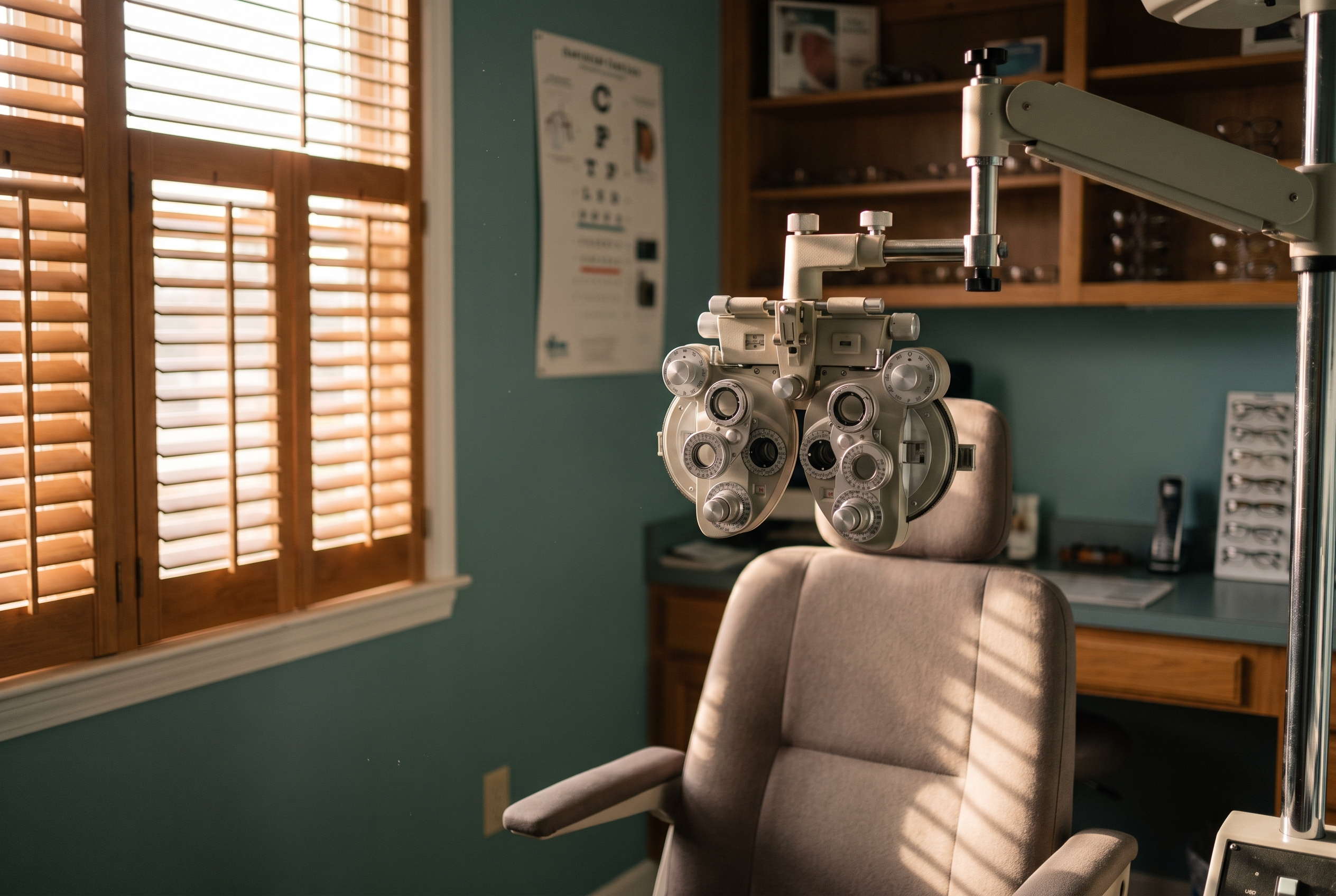
Research presented at the 44th Congress of the European Society of Cataract and Refractive Surgeons has found that a simple, quick test can predict whether a particular kind of laser eye surgery will work for you. The surgery is called laser blended vision. It is a treatment for presbyopia. That is the gradual loss of close-up focus that starts for most people in their forties, and is the reason so many of us end up holding menus at arm's length. The surgery works in an unusual way. One eye is corrected mainly for distance. The other is corrected mainly for near. The brain then blends the two images together. Most people can do this. Some people cannot, and for them the result is uncomfortable rather than helpful. Until now, surgeons have had no reliable way of telling in advance who falls into which group. The research was presented on 12 September 2026 by Brendan Cummings, a consultant ophthalmologist at the Wellington Eye Clinic in Dublin. The test he described uses a phoropter, the familiar piece of equipment with rows of lenses that opticians already have. It takes a couple of minutes and costs nothing extra.
Why this matters
Presbyopia is close to universal. If you live long enough, you get it. It is not a disease and it is not a sign that anything has gone wrong. It is simply the lens inside the eye becoming less flexible with age. Most people manage it with reading glasses or varifocals. Some would rather not. Laser blended vision is one of the options offered, and it is not cheap. In the UK it is almost always a private treatment. That is exactly why a screening test matters. When someone is paying a substantial sum for elective surgery, the worst outcome is not a technical failure. It is a technically perfect operation on a person whose brain was never going to adapt to it. A test that identifies those people beforehand protects them from a decision they cannot easily undo. It also protects surgeons, and it gives the rest of the field something useful: an honest way of saying 'this is not for you' before any money changes hands. That is a small piece of research with a very practical point.
What the evidence actually says
The test itself is straightforward. The optometrist first sharpens your distance vision as well as it will go. That becomes your benchmark, counted as 100 per cent. Then they blur one eye, using lenses, to imitate what near correction would feel like. They ask you a simple question: how does your vision compare now? Then they repeat it with the other eye blurred instead. If you still report at least 80 per cent quality with one eye blurred, you are considered a suitable candidate. The same test also shows which of your eyes should be the one corrected for distance. The numbers behind it: 1,341 patients were assessed. Thirty of them, which is 1.66 per cent, were identified as unsuitable. Among those who went ahead with treatment, 96.9 per cent adapted successfully. Cummings said the test's predictive value held 'for all patients regardless of their prescription before surgery'. Two honest caveats. First, this was presented at a conference. Conference presentations have not always been through the full peer-review process that a journal paper goes through. Second, the figures come from one clinic's own patients. That is a large group, but it is not the same as several independent clinics reporting the same thing.
Practical advice
If you are in your forties or older and your reading vision has changed, get your eyes tested properly. Free NHS sight tests are available to over-60s, and to plenty of other groups including people with diabetes and those with a family history of glaucoma. A sight test is not only about your prescription. It can pick up glaucoma, cataracts and signs of diabetes long before you notice anything yourself. That is reason enough to book one every two years. If you are considering laser surgery for reading vision, ask the clinic directly whether they carry out a blended vision suitability test, and ask to see your own result. A clinic that is happy to tell some people not to have surgery is generally a clinic worth trusting. Do not rush. Presbyopia is not an emergency and it is not going to damage your eyes. And if you have sudden vision changes, flashes, floaters or pain, that is different. Treat it as urgent and seek medical help the same day.
What to know
A simple test, using equipment opticians already own, appears to predict who will adapt to laser blended vision surgery for age-related reading difficulty. It works by blurring one eye at a time and asking the patient how their vision compares. In 1,341 patients, 30 were flagged as unsuitable, and 96.9 per cent of those treated adapted well. The research was presented at the European Society of Cataract and Refractive Surgeons congress on 12 September 2026. It is conference data from a single clinic, so treat it as promising rather than settled. But the underlying message is sound: if you are paying for elective eye surgery, ask to be screened first. Sources: Medical Xpress, 'Simple perception test can accurately predict success of laser surgery for age-related vision loss', 12 September 2026, https://medicalxpress.com/news/2026-09-simple-perception-accurately-success-laser.html ; European Society of Cataract and Refractive Surgeons, research presented at the 44th ESCRS Congress, 12 September 2026, https://www.escrs.org ; EurekAlert, news release from the European Society of Cataract and Refractive Surgeons, 12 September 2026, https://www.eurekalert.org/news-releases/browse?view=summaries&date=09/12/2026 This article is for general information and does not replace advice from a doctor, optometrist, pharmacist or other qualified healthcare professional. Always discuss elective eye surgery with a qualified ophthalmologist.
Related articles
A new lung cancer drug beat the current standard on survival. Here is the detail
Results from a large lung cancer trial were presented on 12 September 2026 at the World Conference on Lung Cancer, run by the International Association for the…
The body's own brake on inflammation - and a drug that helped it work
Researchers at University College London have described a natural 'off switch' that helps the body stop inflammation once it has done its job. The work was publ…