
Ice that stays solid above 1,800 degrees: a new form found
What happened
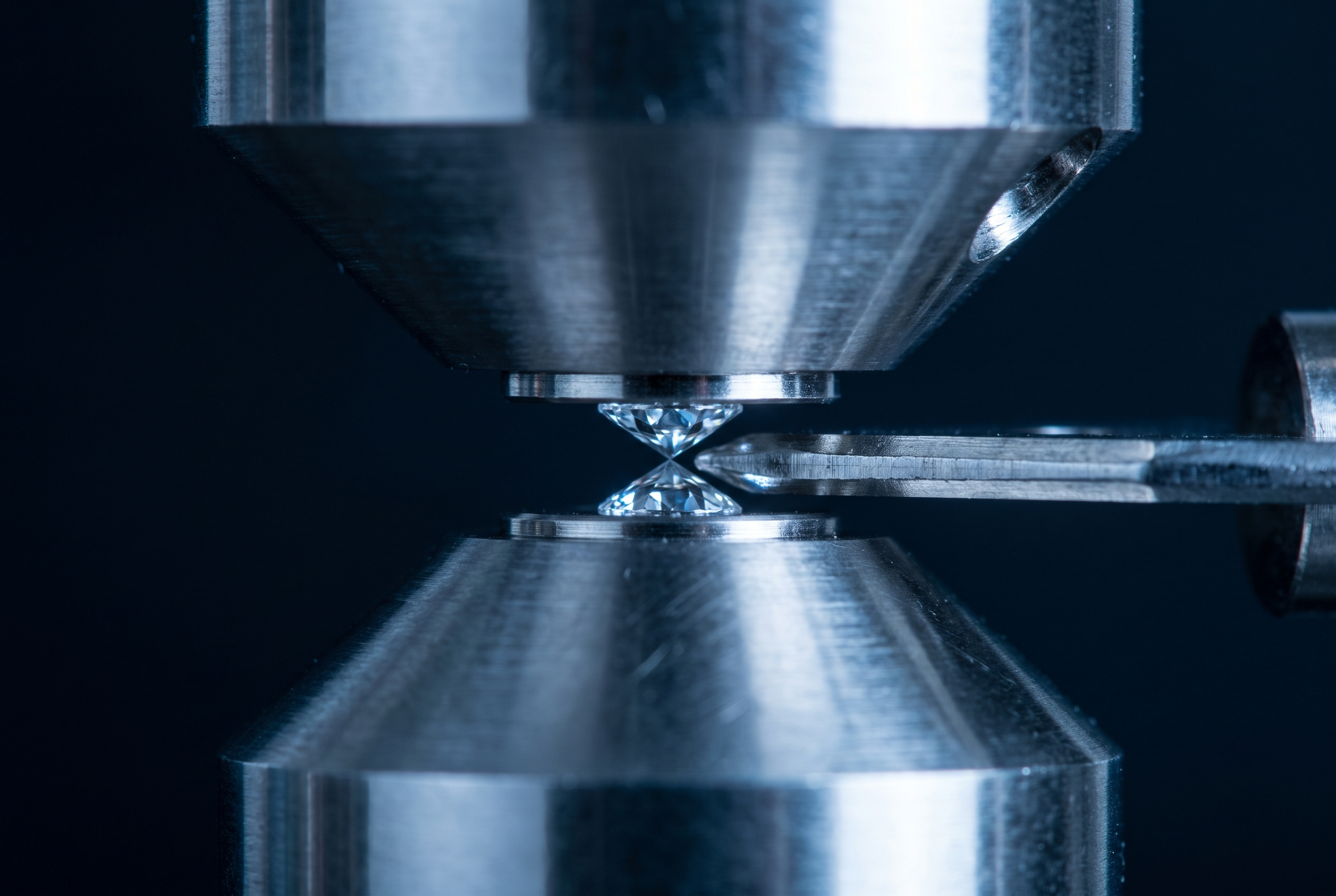
Physicists in France have observed a form of water ice that had been predicted for years but never clearly seen. The work was led by Alexis Forestier at the CEA, France's Alternative Energies and Atomic Energy Commission. It was published in Physical Review Letters under the title 'Observation of Hexagonal Close-Packed Water Ice at Conditions in Ice Giant Planetary Interiors', and reported on 11 September 2026. The method sounds almost absurd. The team placed a speck of water between the tips of two diamonds and squeezed. The pressure reached above 230 gigapascals, which is millions of times the pressure of the air at the Earth's surface. Then they fired lasers at it, heating it past 1,800 kelvin, roughly 1,500 degrees Celsius. Under those conditions water does not boil away. It does something stranger. It enters a state called superionic ice, where the oxygen atoms lock into a rigid grid while the hydrogen nuclei flow freely through that grid like a liquid. Because those charged hydrogen nuclei are moving, the ice conducts electricity. Superionic ice was already known. What is new is its shape. Scientists had assumed the oxygen atoms arranged themselves in a pattern called face-centred cubic. The French team found them instead in a hexagonal close-packed arrangement, usually shortened to hcp. It had been predicted, but never properly observed.
Why this matters
This is not really a story about ice. It is a story about two planets we understand badly. Neptune and Uranus are known as the ice giants. Most of what sits beneath their clouds is thought to be a hot, dense soup of water, ammonia and methane under crushing pressure. Conditions of exactly the kind this experiment recreated. Both planets have magnetic fields that are frankly odd. Unlike Earth's, which is reasonably tidy and roughly lines up with the poles, theirs are tilted at strange angles and are off-centre. Nobody has a fully satisfying explanation. The leading idea involves electrically conducting material moving inside the planet. Superionic ice conducts electricity. So the precise structure it takes matters, because a different atomic arrangement means different properties: how heat moves through it, how electrical charge flows, how it behaves under stress. If a good part of Neptune's and Uranus's interiors is hcp superionic ice rather than the face-centred cubic form everyone assumed, then the models built on that assumption need revisiting. There is a nice piece of timing to this too. Only one spacecraft has ever visited either planet, Voyager 2, briefly, in the 1980s. A mission to Uranus has been ranked a high priority by planetary scientists. Better laboratory work now means better questions to ask if a spacecraft ever gets there.
What the evidence actually says
This is solid experimental physics, and it is worth saying what makes it convincing. The researchers did not calculate this or simulate it. They made it and observed it. Diamond anvil cells combined with laser heating are a well-established technique for recreating planetary interior conditions, and Physical Review Letters applies serious scrutiny. The structure had been theoretically predicted beforehand, and the experiment found what theory expected, which is the sort of agreement that gives physicists confidence. The honest limits are about scale and inference. The sample is microscopic, held for a very short time. That is not a criticism, it is simply what is possible at these pressures, but it is a long way from a planet's worth of material sitting there for billions of years. The jump from laboratory to planetary interior is also an inference rather than an observation. Nobody has measured what is inside Neptune. We match laboratory conditions to our best estimates of pressure and temperature down there and reason from that. Those estimates could be wrong. And real ice giant interiors are not pure water. They contain ammonia, methane and other materials mixed in, which can change how things behave. So the fair summary is this: a predicted structure has been confirmed to exist under the right conditions, and that is a genuine result. Whether it dominates inside Neptune and Uranus is a well-supported hypothesis rather than a settled fact.
Practical advice
There is nothing to do here. This is a story to enjoy rather than act on. But a few things are worth carrying away. When you see planetary science headlines, notice the difference between something measured in a laboratory and something measured at the planet. Both are valuable. They are not the same kind of claim, and the coverage does not always make that obvious. If you want to follow this properly, go to the source institutions. The CEA publishes accounts of its own work, and in the UK the Royal Astronomical Society and university physics departments produce readable explanations aimed at the public. If you have a child interested in science, this experiment is a genuinely good one to describe. Two diamonds, a speck of water, a laser, and a result that changes how we picture a planet four billion kilometres away. It is a clear illustration that you do not always have to go somewhere to learn about it. And for anyone who enjoys looking up: Neptune and Uranus are both visible from the UK with modest equipment on a clear, dark night, Uranus with good binoculars and Neptune with a small telescope. Local astronomical societies run public observing evenings across the country and are usually delighted when people turn up.
What to know
Physicists at the CEA in France have observed a new form of superionic water ice, in which oxygen atoms sit in a hexagonal close-packed arrangement rather than the face-centred cubic structure previously assumed. They produced it by squeezing water between diamonds above 230 gigapascals and heating it past 1,800 kelvin with lasers. Superionic ice conducts electricity, because its hydrogen nuclei flow freely through a rigid oxygen lattice. That makes its exact structure relevant to the strange, tilted magnetic fields of Neptune and Uranus. The experiment is real and the structure was directly observed. The link to planetary interiors is a strong inference rather than a direct measurement, and real ice giants contain more than just water. The work was published in Physical Review Letters and reported on 11 September 2026. Sources: Physical Review Letters, 'Observation of Hexagonal Close-Packed Water Ice at Conditions in Ice Giant Planetary Interiors' (Forestier et al., CEA), 2026, DOI 10.1103/sdrk-3m4t; Phys.org, 'Scientists discover a strange new form of ice that could help explain the interiors of Neptune and Uranus', 11 September 2026, https://phys.org/news/2026-09-scientists-strange-ice-interiors-neptune.html; ZME Science, 'Scientists Made Ice Stay Solid Above 2,000C', September 2026, https://www.zmescience.com/science/news-science/superionic-ice-2000-deg-c/ This article is for general information and does not replace advice from a doctor, pharmacist or other qualified healthcare professional on any health matter.
Related articles

A pain-relief patch the size of a plaster, controlled from a phone
A research team in South Korea has built a small wearable device that delivers electrical pain relief through the skin, and can be controlled remotely from a sm…
Something dark is hiding in Venus's clouds, and scientists just narrowed down what it can be
Venus has a mystery that has sat unsolved for roughly a century. Seen in ordinary light, the planet is a smooth, featureless cream-yellow ball. Look at it in ul…
Scientists looked a quarter of a proton deep inside an atom - and found something odd
Physicists working on the ALICE experiment at CERN's Large Hadron Collider have managed to look deeper inside atomic nuclei than anyone has before. What they fo…