
A jelly that heals its own cuts in 15 minutes - and can be recycled
What happened
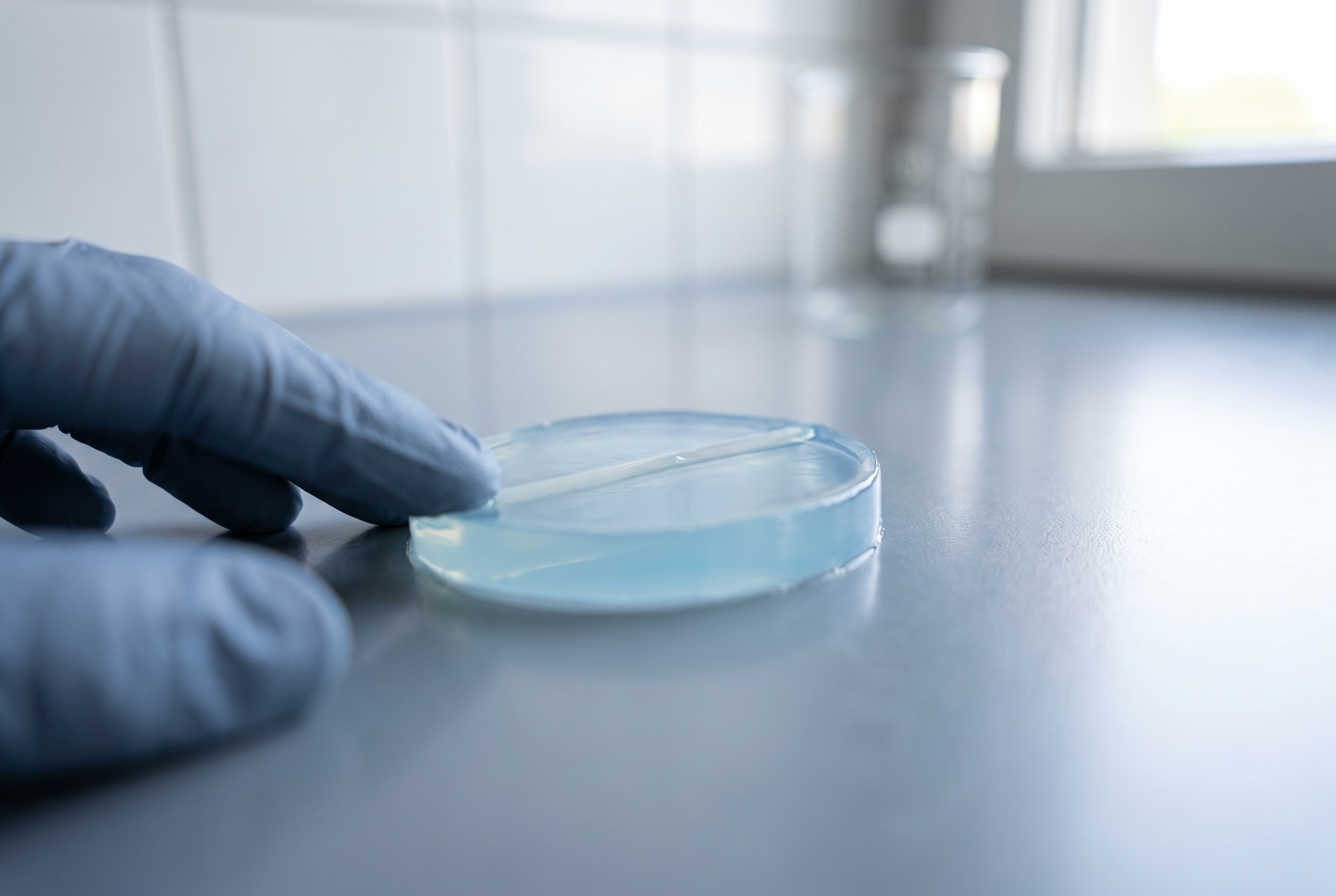
Chemists at Northeastern University in the United States have made a hydrogel that repairs its own cuts and can be completely taken apart and rebuilt. The work was published in the journal Advanced Materials on 9 September 2026, under the title "True Closed-Loop Recyclable Hydrogels Enabled by Imine Boronic Ester Crosslinking". It came from the laboratory of Diego M. Alzate-Sánchez, a professor of chemistry and chemical biology at Northeastern, working with a PhD student in his group and a collaborator at Oak Ridge National Laboratory. A hydrogel is a soft, water-filled material. You have almost certainly touched one. Contact lenses are hydrogels. So are the absorbent cores of nappies, many wound dressings and quite a few cooling face masks. When the team cut their gel in half and pressed the pieces back together, the join disappeared in about 15 minutes.
Why this matters
Ordinary hydrogels have a problem that has nothing to do with how well they work. It is what happens afterwards. They are usually held together by permanent chemical links. That makes them sturdy, but it also means you cannot unmake them. As the PhD student on the project put it, once you have made that material, there is no way to dissolve it in any solvent. So they go in the bin. Wound dressings, nappies and disposable contact lenses are used in enormous numbers, once each. This new gel is built differently. The permanent links have been swapped for reversible ones. Under the right conditions the whole network can be pulled apart, the ingredients recovered, and the same gel built again. Researchers call this closed-loop recycling, and it is much rarer than the ordinary kind.
What the evidence actually says
The self-healing and the recycling come from the same design choice, which is quite elegant. When the links between the polymer chains form, they produce a little water as a by-product. That water keeps the links in a restless state, constantly breaking and re-forming. So when you cut the gel, there are always loose ends available to reach across the gap and join up again. Fifteen minutes is a laboratory result, on a clean cut, in controlled conditions. That is not the same as a dressing repairing itself on someone's arm. The listed possible uses, contact lenses, wound dressings, nappies, cooling face masks, drug delivery and water purification, are exactly that: possible. None has been tested in a medical trial. Anything intended to touch a wound or an eye would need years of safety testing and regulatory approval before it reached a patient. That is not a criticism of the work. It is simply the distance between a clever material and a product on a shelf.
Practical advice
There is nothing to buy here yet, so treat this as something to watch rather than act on. If you use contact lenses, the sensible habits are unchanged: follow the replacement schedule you were given, never sleep in lenses that are not designed for it, and get sore or red eyes checked promptly rather than waiting. If you are caring for a wound at home, use the dressing your nurse or pharmacist recommended and change it as instructed. Signs that need review are spreading redness, increasing pain, heat, swelling or a bad smell. On the environmental side, the honest answer is that used medical dressings are not recyclable and should not be put in household recycling. If you get through a lot of dressings, ask your community nursing team whether there is a local disposal route. Unused, in-date medical supplies are a different matter. Ask before you throw them away.
What to know
A team at Northeastern University has created a hydrogel that heals its own cuts in about 15 minutes and can be fully broken down and rebuilt from the recovered ingredients. The trick is replacing permanent chemical links with reversible ones, which makes the material both self-repairing and truly recyclable. The study appeared in Advanced Materials on 9 September 2026. Suggested uses include contact lenses, wound dressings, nappies and drug delivery, but none of these has been tested in people. This is promising laboratory science at an early stage. Sources: Northeastern Global News, "This Self-Healing Hydrogel Can Also Be Fully Recycled", 9 September 2026, https://news.northeastern.edu/2026/09/09/self-healing-material-hydrogel-research/ | Phys.org, "Fully recyclable hydrogel begins healing itself within minutes", 10 September 2026, https://phys.org/news/2026-09-fully-recyclable-hydrogel-minutes.html | Advanced Materials, "True Closed-Loop Recyclable Hydrogels Enabled by Imine Boronic Ester Crosslinking", 9 September 2026, https://onlinelibrary.wiley.com/journal/15214095 This article is for general information and does not replace advice from a doctor, pharmacist or other qualified healthcare professional.
Related articles
A pain-relief patch the size of a plaster, controlled from a phone
A research team in South Korea has built a small wearable device that delivers electrical pain relief through the skin, and can be controlled remotely from a sm…

Something dark is hiding in Venus's clouds, and scientists just narrowed down what it can be
Venus has a mystery that has sat unsolved for roughly a century. Seen in ordinary light, the planet is a smooth, featureless cream-yellow ball. Look at it in ul…

Scientists looked a quarter of a proton deep inside an atom - and found something odd
Physicists working on the ALICE experiment at CERN's Large Hadron Collider have managed to look deeper inside atomic nuclei than anyone has before. What they fo…