
Cells with giant centres may be an early warning sign of cancer
What happened
A research team at Nagoya University in Japan has reported that cells with unusually large nuclei may mark the very beginning of cancer. Their study was published in the journal Redox Biology and announced on 10 September 2026. The nucleus is the control centre of a cell. It holds the DNA. Most nuclei in a tissue look roughly the same size. Some do not, and those oversized ones are what the team looked at. The researchers worked with rats, using a model of kidney cancer driven by iron. Iron is essential for life, but in excess it causes a kind of chemical damage called oxidative stress. Within one week of giving iron, giant-nucleus cells appeared. These cells had switched on cancer-related genes, including two called Myc and Met. They had also become resistant to ferroptosis, a form of cell death that depends on iron. The team also studied rats carrying a fault in the Brca1 gene. Those rats produced giant-nucleus cells with a different biological profile, which fits the idea that a weakened DNA repair system lets more damaged cells survive.
Why this matters
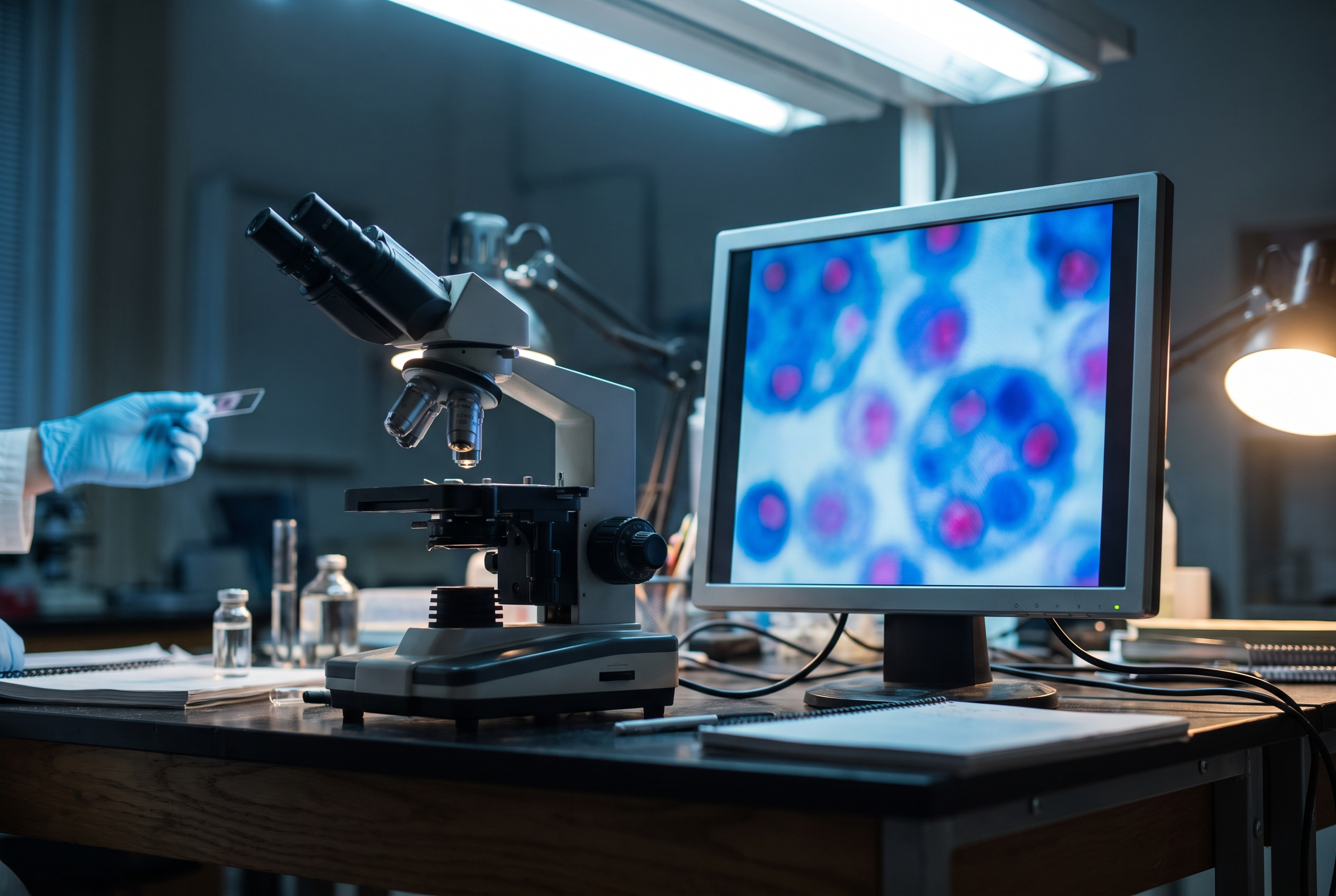
Most cancer research aims at cancer that already exists. This work is aimed further back, at the stage before a tumour forms. There is a practical reason to be interested. Giant nuclei are easy to see. You do not need an expensive genetic test to spot them. A pathologist looking down a microscope at a tissue sample can see that a nucleus is much bigger than its neighbours. There was a second finding that may matter even more. Cells sitting near the giant-nucleus cells looked normal under the microscope, but their gene activity had already changed in ways that helped them survive. In other words, the damage may be wider than the obviously odd-looking cells suggest. BRCA1 is a name many people recognise, because faults in it raise the risk of breast and ovarian cancer. This study looked at kidney tissue in rats, not at breast tissue in people, so the link is about the biology of DNA repair rather than about any particular cancer.
What the evidence actually says
This is laboratory research in rats. That is an important limit, and it is worth saying plainly rather than burying it. The findings do not mean there is now a test you can ask for. They do not mean a large nucleus seen on any scan or sample is cancer. They do not change any screening programme or any treatment. What the team did do was careful. They combined single-cell spatial technology, which shows which genes are switched on and exactly where in the tissue, with detailed measurement of nucleus shape and size, studies of the cell's energy machinery, and comparison against human cancer datasets. That last step matters. Checking against human data is how researchers start to test whether an animal finding has anything to say about people. It is a first step, not a conclusion. The honest summary is that this is a promising idea with a clear biological mechanism behind it, at an early stage, and years away from anything a patient would notice.
Practical advice
Nothing in this study changes what you should do today. But the general rules on cancer are worth repeating, because they are the ones that actually save lives now. Go to your screening appointments. In the UK that means bowel screening, breast screening and cervical screening when you are invited. Taking up an invitation is one of the strongest things you can do. Get unexplained changes checked. A lump, blood where it should not be, a cough that will not settle after three weeks, a mole that changes, unexplained weight loss. Most turn out to be nothing. The ones that are not do far better when found early. If cancer runs strongly in your family, particularly breast, ovarian, bowel or prostate cancer in close relatives or at young ages, tell your GP. There are genetic services for exactly this. And the unglamorous ones still matter most: not smoking, keeping alcohol low, staying active and keeping to a healthy weight.
What to know
Researchers at Nagoya University found that cells with unusually large nuclei appeared within a week of iron-driven damage in rats, switched on cancer-related genes and resisted a form of cell death. Rats with a Brca1 fault produced different versions of these cells. Because giant nuclei are easy to spot under a microscope, the team hopes they could one day serve as an early warning sign. This is early animal research. It does not change screening, testing or treatment today. Keep taking up your screening invitations and get unexplained changes checked. Sources: Nagoya University, "Giant-nucleus cells are key markers for early-stage cancer, study shows", 10 September 2026, https://en.nagoya-u.ac.jp/news/articles/pr-giant-nucleus-cells-are-key-markers-for-early-stage-cancer-study-shows/ | Redox Biology / PubMed, "Iron-catalyzed oxidative stress reveals an exposome-related ferroptosis-resistant karyomegalic niche in BRCA1-linked renal carcinogenesis", 2026, https://pubmed.ncbi.nlm.nih.gov/42442115/ | EurekAlert (AAAS), "Giant-nucleus cells are key markers for early-stage cancer, study shows", 11 September 2026, https://www.eurekalert.org/news-releases/browse?section=Medicine%20%26%20Health This article is for general information and does not replace advice from a doctor, pharmacist or other qualified healthcare professional.
Related articles

A new lung cancer drug beat the current standard on survival. Here is the detail
Results from a large lung cancer trial were presented on 12 September 2026 at the World Conference on Lung Cancer, run by the International Association for the…
A two-minute test that tells you whether laser surgery for reading vision will suit you
Research presented at the 44th Congress of the European Society of Cataract and Refractive Surgeons has found that a simple, quick test can predict whether a pa…
The body's own brake on inflammation - and a drug that helped it work
Researchers at University College London have described a natural 'off switch' that helps the body stop inflammation once it has done its job. The work was publ…