
A comet from another star is bursting with alcohol, and that is a real clue
What happened
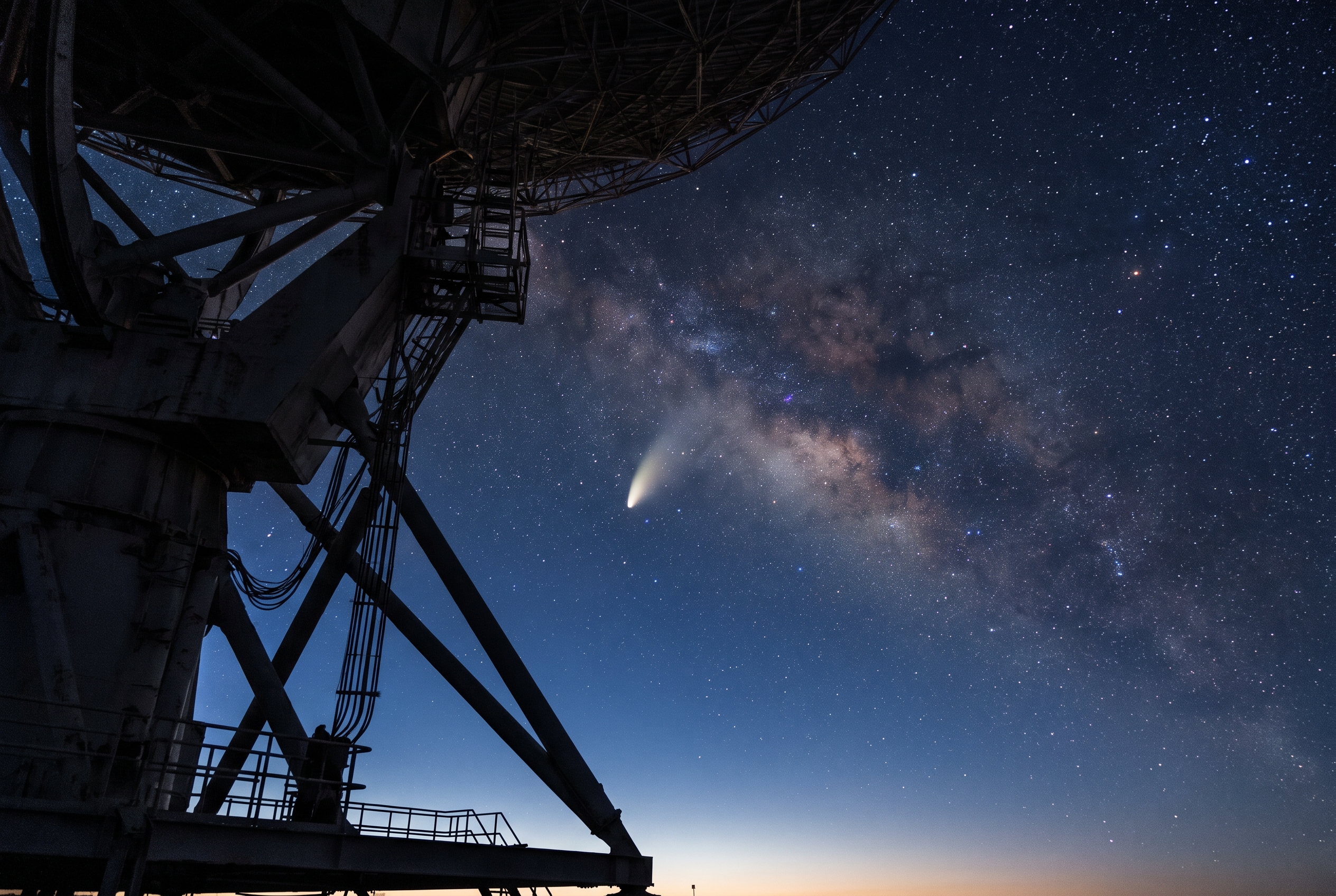
Astronomers have found that 3I/ATLAS, only the third object ever confirmed to have come from outside our solar system, is unusually rich in methanol. Methanol is a simple form of alcohol. It is not the kind you would ever drink, but it is a common ingredient in comets and in the clouds of gas and dust where stars are born. Using ALMA, the giant array of radio dishes high in the Chilean Atacama Desert, a team measured how much methanol the comet was releasing compared with hydrogen cyanide, another gas comets give off. On two separate observing dates they measured ratios of roughly 70 and 120. That puts 3I/ATLAS among the most methanol-rich comets ever measured, well beyond what is typical for comets born in our own solar system. The team also noticed something about where the gas was coming from. The hydrogen cyanide seemed to come mainly from the solid nucleus of the comet. The methanol came both from the nucleus and from tiny icy grains floating in the coma, the fuzzy cloud around it. Those grains were behaving like thousands of miniature comets in their own right, releasing methanol as they warmed.
Why this matters
Comets are leftovers. They are the material that never got swept up into planets, kept in deep freeze for billions of years. Reading a comet's chemistry is one of the few ways to sample what conditions were like when a planetary system was forming. Until recently we could only do that for our own solar system. Interstellar objects change that completely. 3I/ATLAS was assembled around a different star, and then thrown out of it. It is a free sample from another planetary system, delivered to our doorstep. So when its chemistry looks different from ours, that is genuinely informative. A methanol to hydrogen cyanide ratio of 70 to 120 suggests the ices in 3I/ATLAS formed in, or later passed through, conditions quite unlike those that shaped most of our comets. Colder, perhaps, or with different amounts of radiation, or a different mix of starting material. This is how a science moves from a sample of one to a sample of many. Every interstellar visitor we can measure tells us whether our own solar system is ordinary or unusual, and that question sits underneath almost everything else we ask about planets and life.
What the evidence actually says
The measurement itself is solid. ALMA is one of the most sensitive instruments in the world for exactly this kind of work, and the team observed on two separate dates and got consistent answers within the range you would expect. What needs care is the interpretation. A ratio between two gases is not the same as a full inventory of what the comet is made of. What a comet releases depends on how warm it is, how fast it is spinning, how much dust is shielding the surface, and where it is on its journey past the Sun. Two comets with identical composition can look different if you catch them at different points. The icy grain finding is a good example of why this matters. If a lot of the methanol is coming from grains in the coma rather than straight from the nucleus, then a simpler measurement taken on a different day might have produced a different number without the comet itself being any different. One other thing worth saying plainly, because it comes up every time an interstellar object appears: there is nothing in these findings that points to anything artificial. A methanol-rich comet is an unusual comet. That is all, and it is quite enough. It helps to know why astronomers care about a ratio at all, rather than just a list of ingredients. Ratios are more reliable than raw amounts. How much gas a comet gives off depends heavily on how close it is to the Sun and how big it is. But the proportion of one gas to another is much more closely tied to the ice the comet is actually made of, so it survives those complications better. Methanol and hydrogen cyanide are a useful pair because they form under different conditions. Methanol builds up on cold dust grains when hydrogen sticks to carbon monoxide, which needs a very cold, dense environment. Hydrogen cyanide forms more readily in warmer gas. So the balance between them acts a bit like a thermometer for the environment where the comet's ices were assembled. A ratio of 70 to 120 tips heavily towards the cold end. That is the reason astronomers describe 3I/ATLAS as having formed under conditions different from most of our own comets, rather than simply saying it is 'weird'. It is a small measurement carrying a large amount of information, which is more or less the definition of good astronomy.
Practical advice
You will not see 3I/ATLAS with the naked eye, and by the time most people read about an interstellar object it is usually already on its way out. But there are a few things worth doing if this sort of news interests you. Follow the observatories rather than the aggregators. ALMA, the European Southern Observatory and NASA all publish plain language summaries of their own results, and they are consistently more careful than the sites that rewrite them. If you want to look at comets yourself, the ones worth chasing are the bright periodic ones, and a decent pair of binoculars on a dark night beats a cheap telescope almost every time. Lincolnshire has some genuinely dark skies once you are away from the towns, which is more than a lot of England can say. Be sceptical of any coverage that leans on the word 'alien'. Interstellar simply means it came from beyond our solar system. It is a description of an origin, not a suggestion about who made it. And if you have children who are curious about this, the ALMA and ESO image galleries are free, enormous, and a far better way in than any textbook.
What to know
3I/ATLAS, the third confirmed interstellar object, is one of the most methanol-rich comets ever measured. Using the ALMA telescope array in Chile, astronomers measured methanol to hydrogen cyanide ratios of about 70 and 120 on two dates, far above what is typical for comets from our own solar system. Much of the methanol appears to come from tiny icy grains in the comet's coma, each behaving like a miniature comet. The finding suggests the object's ices formed under conditions different from those in our solar system. Ratios are not a full composition, so interpret with care, and there is nothing here that suggests anything artificial. Sources: ALMA Observatory, 'ALMA Detects Extremely Abundant Alcohol in Interstellar Comet 3I/ATLAS', September 2026, https://www.almaobservatory.org/en/press-releases/alma-detects-extremely-abundant-alcohol-in-interstellar-comet-3i-atlas/ ; ScienceDaily, 'Interstellar comet 3I/ATLAS is bursting with methanol', 9 September 2026, https://www.sciencedaily.com/releases/2026/09/260909005217.htm ; Space.com, 'Interstellar comet 3I/ATLAS is bursting with methanol, new study finds', September 2026, https://www.space.com/astronomy/comets/interstellar-comet-3i-atlas-is-bursting-with-methanol-new-study-finds This article is for general information. Methanol is toxic and is never safe to drink in any quantity. Nothing here replaces advice from a doctor, pharmacist or other qualified healthcare professional.
Related articles

A pain-relief patch the size of a plaster, controlled from a phone
A research team in South Korea has built a small wearable device that delivers electrical pain relief through the skin, and can be controlled remotely from a sm…
Something dark is hiding in Venus's clouds, and scientists just narrowed down what it can be
Venus has a mystery that has sat unsolved for roughly a century. Seen in ordinary light, the planet is a smooth, featureless cream-yellow ball. Look at it in ul…
Scientists looked a quarter of a proton deep inside an atom - and found something odd
Physicists working on the ALICE experiment at CERN's Large Hadron Collider have managed to look deeper inside atomic nuclei than anyone has before. What they fo…