
Semaglutide was linked to nearly 40% fewer asthma attacks in a large UK study
What happened
On 9 September 2026, researchers presented findings at the European Respiratory Society Congress in Barcelona suggesting that semaglutide, the medicine in Ozempic and Wegovy, may do more than lower blood sugar and body weight. Using anonymised electronic medical records from the UK, the team ran four parallel real world studies. Each one compared between roughly 20,000 and 22,000 people who started a GLP-1 receptor agonist with a similar group who started a sulfonylurea, an older type of diabetes tablet. Among people with asthma, those taking semaglutide had nearly 40% fewer asthma attacks. Among people with chronic obstructive pulmonary disease, or COPD, semaglutide was linked to about 20% fewer flare-ups. The work was led by Professor Chloe Bloom, a clinical associate professor in respiratory epidemiology at Imperial College London, and presented by Dr Bohee Lee. One detail is easy to miss and matters a great deal. Three other GLP-1 medicines in the same analysis showed no such link. Whatever is going on, it did not show up across the whole drug class.
Why this matters
Asthma affects around 5.4 million people in the UK, and COPD affects roughly 1.2 million diagnosed people. Both are conditions where the day to day symptoms are only half the story. The other half is the attack or flare-up: the sudden worsening that lands people on steroids, in A&E, or in a hospital bed. Those events are not just frightening. Each severe flare-up can leave lung function slightly worse than before. Cutting them down is one of the main goals of modern respiratory care. There is also a wider question sitting underneath this. Many people with asthma or COPD also live with obesity or type 2 diabetes. Doctors have long suspected that weight and inflammation play a part in how bad airway disease gets. If a medicine already being prescribed to millions turns out to also calm the airways, that would be genuinely useful, because the safety profile is already well mapped. But 'linked to' is not 'caused by', and that distinction is the whole story here.
What the evidence actually says
This was a real world study, not a clinical trial. That means researchers looked back at what happened to people who were already prescribed these medicines, rather than randomly assigning who got what. That design has a real strength: the numbers are large and the people are ordinary patients, not the carefully selected volunteers who often join trials. It also has a well known weakness. People prescribed a newer, more expensive medicine may differ from people prescribed an older tablet in ways the records cannot capture, such as how closely they are monitored or how motivated they are about their health. Researchers use statistical methods to reduce this, but they cannot remove it. The research team was careful about this. Professor Bloom said the findings are encouraging, but that they should not change treatment decisions on their own. She was explicit that people with asthma or COPD should not start a GLP-1 receptor agonist for their lung condition outside current prescribing guidance. It is also important that the findings were presented at a conference. Conference presentations are an early stage of sharing science. They usually have not yet been through full peer review and publication, which is where other experts pull the work apart. Treat these numbers as a strong signal worth following, not a settled fact. What would settle it is a randomised controlled trial designed to test exactly this question. The researchers say that is what is needed next.
Practical advice
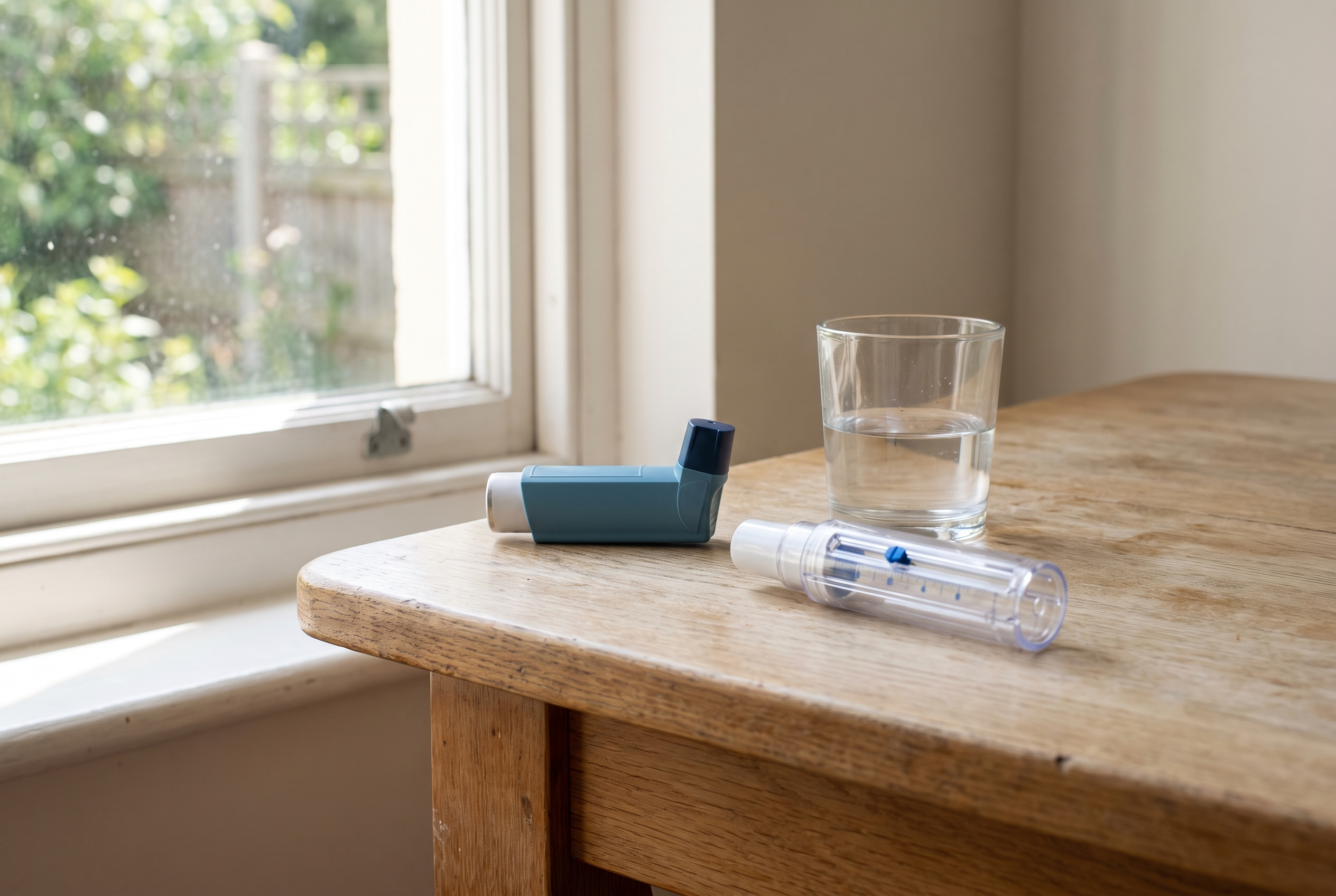
If you have asthma or COPD, the single most useful thing you can do this week has nothing to do with this study. Check your inhaler technique. Studies repeatedly find that a large share of people use their inhalers in a way that sends much of the dose to the back of the throat rather than the lungs. Your pharmacist can check this for free, in a few minutes, and it is one of the few things that reliably reduces attacks. Make sure you have an up to date written asthma action plan or COPD self-management plan, and that you know what to do on a bad day before you are having one. Get your flu jab. The NHS flu programme has already begun for children and pregnant women, and people with long term lung conditions are eligible. Respiratory infections are a leading trigger for flare-ups. If you already take semaglutide for diabetes or weight, keep taking it as prescribed, and do not adjust anything on the strength of this news. If you do not take it, this study is not a reason to ask for it. It was not designed to answer that question. And if you are using your reliever inhaler three or more times a week, that is a sign your asthma is not well controlled. Book a review.
What to know
A large study of UK medical records, presented at the European Respiratory Society Congress on 9 September 2026, linked semaglutide to nearly 40% fewer asthma attacks and about 20% fewer COPD flare-ups compared with an older diabetes medicine. Each comparison involved 20,000 to 22,000 people. Three other GLP-1 medicines showed no such link. This was an observational study presented at a conference, so it shows an association rather than proof of cause, and the researchers themselves say it should not change treatment decisions on its own. Clinical trials are needed. In the meantime, inhaler technique, an action plan and a flu jab remain the things that make the biggest difference. Sources: ScienceDaily, 'Ozempic and Wegovy linked to nearly 40% fewer asthma attacks', 9 September 2026, https://www.sciencedaily.com/releases/2026/09/260909005155.htm ; Medical Xpress, 'Semaglutide linked to 20% fewer COPD flare-ups and nearly 40% fewer asthma attacks', 9 September 2026, https://medicalxpress.com/news/2026-09-semaglutide-linked-copd-flare-ups.html ; European Respiratory Society, ERS Congress 2026, https://www.ersnet.org/events/ers-congress-2026/ This article is for general information and does not replace advice from a doctor, pharmacist or other qualified healthcare professional. Never start, stop or change a prescribed medicine without speaking to your clinician first.
Related articles

A new lung cancer drug beat the current standard on survival. Here is the detail
Results from a large lung cancer trial were presented on 12 September 2026 at the World Conference on Lung Cancer, run by the International Association for the…

A two-minute test that tells you whether laser surgery for reading vision will suit you
Research presented at the 44th Congress of the European Society of Cataract and Refractive Surgeons has found that a simple, quick test can predict whether a pa…

The body's own brake on inflammation - and a drug that helped it work
Researchers at University College London have described a natural 'off switch' that helps the body stop inflammation once it has done its job. The work was publ…