
A dark matter detector recorded one event nobody can explain
What happened
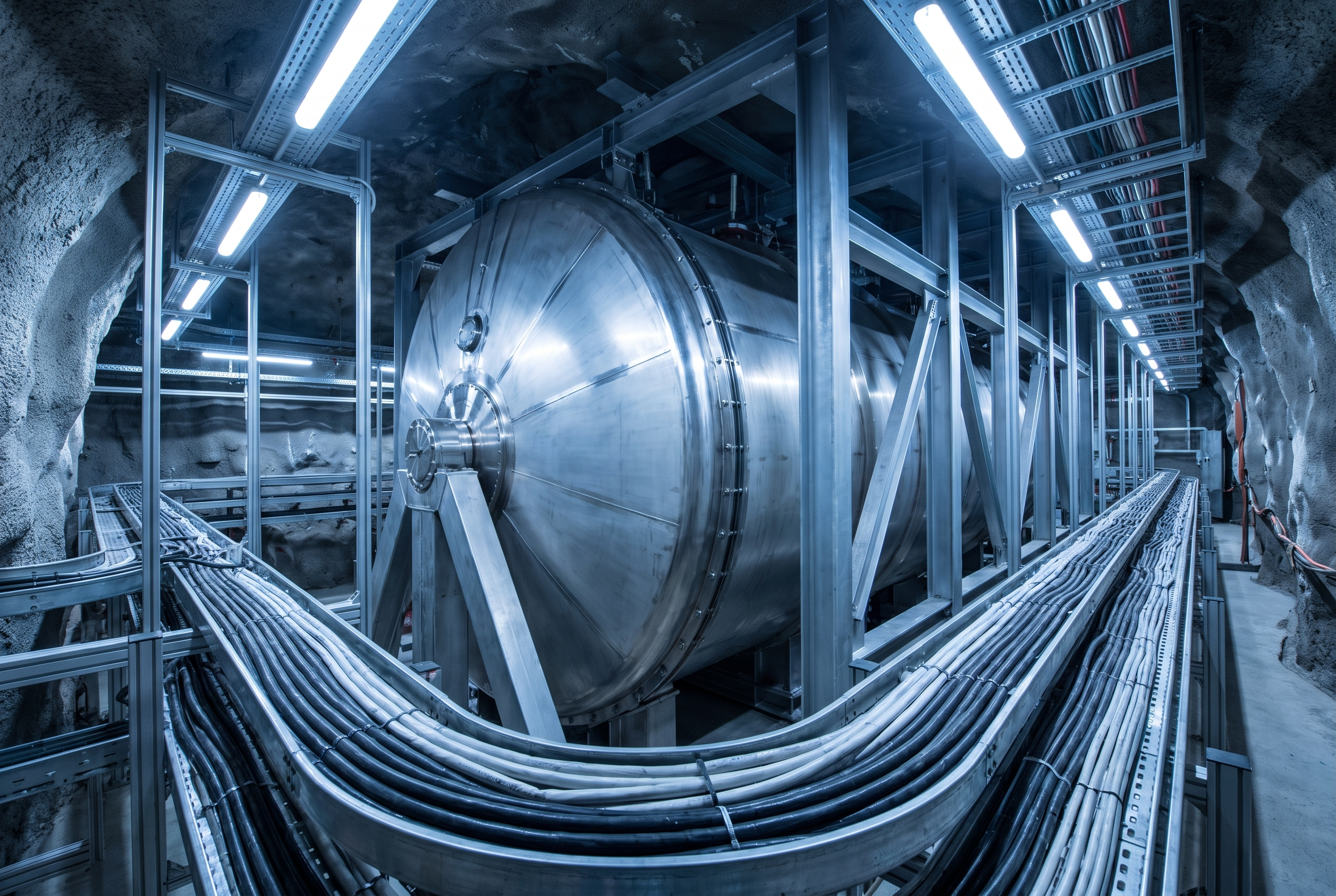
Scientists working on one of the world's most sensitive experiments have reported a single particle interaction they cannot account for. The LUX-ZEPLIN experiment, usually shortened to LZ, sits deep underground in a former gold mine in South Dakota in the United States. It is built to look for dark matter. On 1 September 2026 the collaboration reported the result. It was presented at the TeV Particle Astrophysics conference in Japan, and the team plan to submit a paper to the journal Physical Review Letters. UK institutions including Imperial College London are part of the collaboration. The event itself is remarkable mainly for how ordinary it sounds. One particle interaction. It was recorded on a single day in June 2023, and has survived months of intensive checking since. The team went through every known source of background - natural radioactivity, cosmic rays, contamination in the detector materials - and could not find one that explains it. Their estimate is that there is roughly a 0.5 per cent chance the event came from a known source. In the language physicists use, that is about 2.6 sigma. If it were dark matter, the properties would suggest a particle heavier than about 200 times the mass of a proton.
Why this matters
Dark matter is one of the largest open questions in science. When astronomers measure how galaxies spin and how they pull on each other, the numbers do not work. There is far more gravity than the visible matter can account for. The usual explanation is that most of the matter in the universe is something we cannot see, which does not give off or absorb light. That is roughly five times as much stuff as everything we can see, and nobody knows what it is. For decades, experiments have been built to try to catch a dark matter particle passing through the Earth. LZ is among the largest and most sensitive of them. It uses a large tank of liquid xenon, watched by arrays of light sensors, buried deep enough that most cosmic rays are filtered out by the rock above. So far, these experiments have mostly produced silence. That silence has itself been useful, ruling out whole families of theories. A single unexplained event is not an answer. But it is the most interesting thing this experiment has reported.
What the evidence actually says
The team have been notably careful, and it is worth understanding why. Physics has a standard for claiming a discovery: five sigma. That corresponds to roughly a one in 3.5 million chance that a result is a fluke of the background. This result is about 2.6 sigma. That is nowhere near the threshold. There is a good reason the bar is set so high. Rare events happen. If you look at enough data for long enough, unusual things will show up by chance alone. The history of particle physics contains a long list of promising signals at two or three sigma that faded away as more data arrived. The researchers are not claiming to have found dark matter. They have reported an event they cannot explain, published their reasoning, and invited scrutiny. That is exactly the right way to handle it. It is also worth noting what makes this one unusual. It is not a statistical bump in a graph made of many events. It is a single interaction that survived months of dedicated efforts to explain it away. The next step is more data. LZ continues to run, and if events like this one are real, more should appear over time. If none do, this one will most likely be recorded as a rare background nobody had modelled properly. Either outcome is science working correctly.
Practical advice
This story has no direct effect on daily life, but it is a good opportunity to practise reading science news well. Watch for the sigma. If a physics result is described as two or three sigma, it is interesting but unconfirmed. Five sigma is the discovery threshold. Any headline that ignores this distinction is not being straight with you. Watch for who is claiming what. Here, the researchers themselves are actively cautioning against over-reading their result. When the scientists are more restrained than the headline, trust the scientists. Watch for the word "hint". Physicists use it carefully. It usually means: this is worth another look, and we are telling you now so that nobody accuses us of hiding it later. And be patient. The follow-up on this will take years, not weeks. That is normal. If you want to follow the story properly, Imperial College London and the other collaborating institutions publish updates in plain English, and the eventual Physical Review Letters paper will be the place where the claim is formally tested.
What to know
The LUX-ZEPLIN dark matter experiment recorded a single particle event, captured in June 2023, that no known background can explain after months of checking. The team estimate about a 0.5 per cent chance it came from a known source - roughly 2.6 sigma. The threshold for claiming a discovery in physics is five sigma. The researchers are explicitly not claiming to have detected dark matter. They have reported the event, presented it at a conference and are submitting it for peer review. If the signal is real, more events should follow as the experiment keeps running. If not, it will be filed as a rare fluke. Both are ordinary outcomes in this field. Sources: Northwestern University, "Dark matter detector picks up a mysterious signal", September 2026, https://news.northwestern.edu/stories/2026/09/dark-matter-detector-picks-up-a-mysterious-signal ; Imperial College London, "Dark matter hunt takes unexpected turn after puzzling signal spotted in LZ detector", September 2026, https://www.imperial.ac.uk/news/articles/natural-sciences/physics/2026/dark-matter-hunt-takes-unexpected-turn-after-puzzling-signal-spotted-in-lz-detector/ ; ABC News, "'Exciting hint' of dark matter spotted by LUX-ZEPLIN detector, physicists report", 2 September 2026, https://www.abc.net.au/news/science/2026-09-02/dark-matter-lux-zeplin-discovery-cautious-results/107097774 This article is for general information. It is science reporting rather than health advice, and does not replace guidance from a doctor, pharmacist or other qualified healthcare professional.
Related articles

Switched on in 1956, switched off in 2003, and now being taken apart piece by piece
Seventy years ago, in October 1956, Queen Elizabeth II opened Calder Hall on the Sellafield site in west Cumbria. It was the world's first nuclear power station…
25 storms, £179,000 of delay each, and ten weather stations bolted to masts already standing
On 14 October 2026, Network Rail announced that its Wales and Borders route has become the first in Britain to turn existing railway radio masts into weather st…
Two dead satellites, 17,000 mph, and one refuellable spacecraft sent to fetch them
On 15 October 2026, the UK government confirmed funding for a mission to go up and fetch two dead satellites. It is called the UK Active Debris Removal mission…