
Scientists dropped half an atom and measured what gravity did to it
What happened
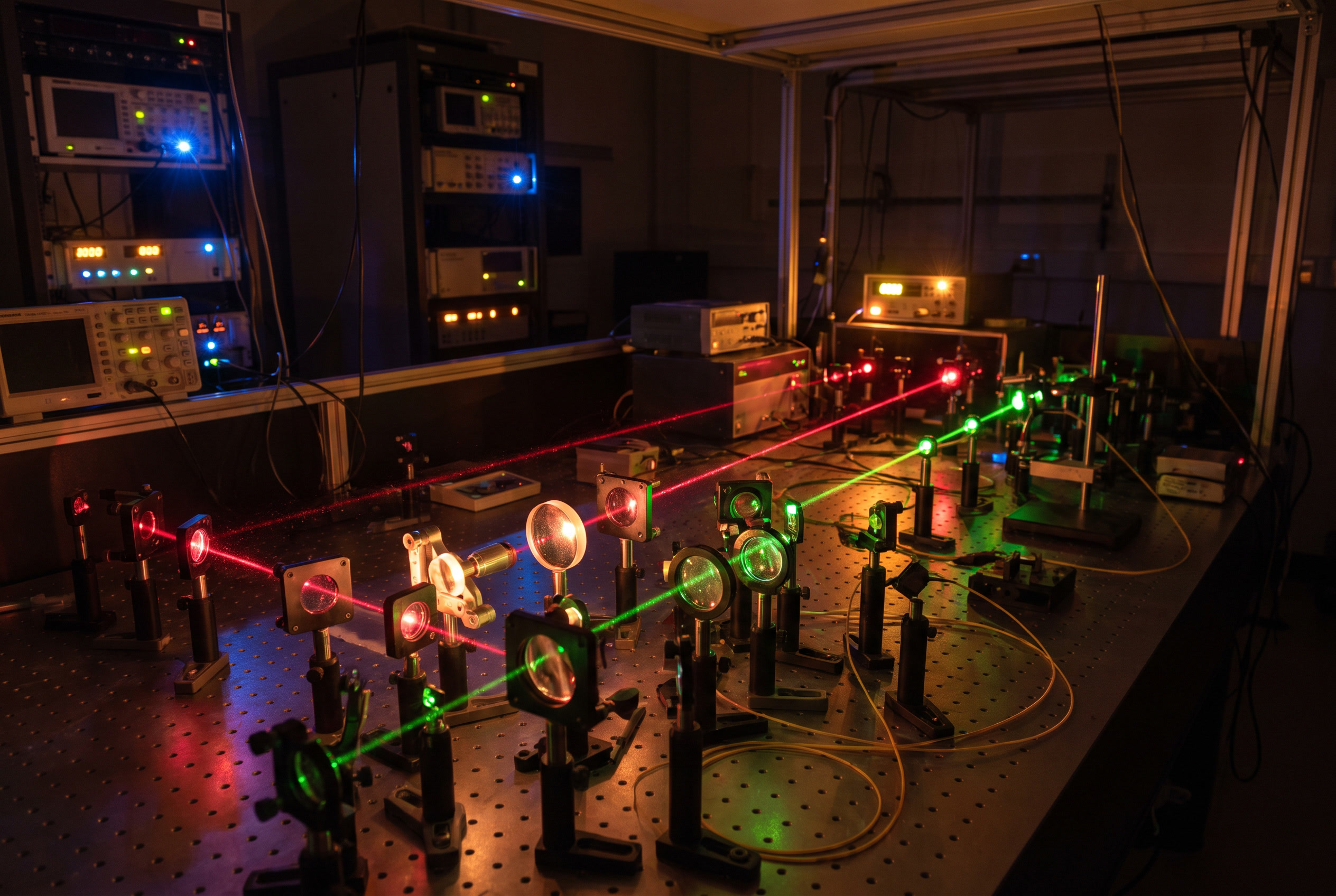
An international team of physicists has, for the first time, directly measured what gravity does to a single atom while it is in two places at once. The work was published in the journal Science Advances on 2 September 2026, and reported by the University of Oxford's Department of Physics on 8 September 2026. The experiment was run at Ben-Gurion University of the Negev in Israel, with collaborators at the University of Ulm, the University of Oxford, the University of Southampton, the German Aerospace Center and Texas A&M University. Professor Ron Folman of Ben-Gurion led the study. The apparatus has a good name: the Quantum Galileo Interferometer, after Galileo's experiments on falling objects. Here is roughly what they did. They cooled rubidium atoms to just above absolute zero, close to a specially built chip. In quantum physics, a very cold atom behaves less like a tiny ball and more like a spread-out wave. The team split that wave into two paths. One path was held still, balanced by carefully tuned magnetic forces. The other was allowed to fall freely under gravity. Then they brought the two halves back together. When waves recombine, they interfere, and the pattern reveals how far out of step they have drifted. That difference is called a phase. Theory predicted a very specific value for the phase a falling matter wave should pick up - the quantum free-fall gauge phase. The measured value matched the prediction.
Why this matters
Modern physics rests on two enormously successful theories that do not fit together. Einstein's general relativity describes gravity, planets and stars. Quantum mechanics describes atoms and particles. Each works beautifully in its own domain. Nobody has managed to combine them. One of the ideas at the heart of Einstein's picture is the equivalence principle. In plain terms, it says everything falls at the same rate regardless of what it is made of. Drop a hammer and a feather in a vacuum and they land together. That has been tested to extraordinary precision for ordinary objects. It has been much harder to test for a genuinely quantum object, where an atom is not simply "falling" but is a wave spread across two paths at once. This experiment took that test into the quantum world and found the theory holds. That is a meaningful result, and it is also a modest one. It is a careful measurement in a place where physics had not yet looked, which is exactly the sort of place surprises tend to hide.
What the evidence actually says
It is worth being precise about what this experiment does not show, because the headlines around this kind of research often stretch. It does not unify quantum mechanics and gravity. There is still no theory of quantum gravity. It does not show that gravity itself is quantum. The experiment treats gravity as a background field and asks how a quantum object responds to it. That is a different question from whether gravity has its own quantum nature. It does not test Roger Penrose's proposal that quantum behaviour breaks down for sufficiently massive objects. The atoms used here are far too small, and the superpositions lasted far too briefly, to say anything about that. What it does show is a first direct measurement of a specific predicted effect, and agreement with theory. The authors are appropriately measured about it. Lead author Professor Ron Folman described it as "a unique paper... about one of the most fundamental questions in physics". Co-author Professor Vlatko Vedral of Oxford said the experiment "pushes quantum mechanics into one of its most intriguing frontiers". Both statements are about opening a door rather than walking through it. The wider value is technical as well as philosophical. Atom interferometers of this kind are becoming real instruments. Versions of the technology are already used to measure gravity very precisely, which has practical uses in surveying, mapping underground structures and navigation without satellites.
Practical advice
This is one of those stories where the honest practical advice is: enjoy it, and be sceptical of anyone who sells you something on the back of it. If you read a headline claiming this experiment proves gravity is quantum, or that it unifies physics, the headline has gone further than the paper. A reliable habit with science news is to look for three things. Which journal published it. Whether the researchers themselves describe it as a first step or a conclusion. And whether the write-up mentions what the study cannot show. This one passes all three tests, which is why it is worth reading about. If you have a curious teenager at home, this is a genuinely good story to share. It involves cooling atoms to nearly absolute zero, splitting them in two, and dropping half. It is also a clean example of how science actually works: not a sudden revelation, but a careful measurement of something a theory said should be there. The Science Advances paper is publicly listed, and the University of Oxford's physics department has written it up in accessible language.
What to know
Physicists split the quantum wave of a single ultracold rubidium atom into two paths, held one still and let the other fall, then recombined them and measured the difference gravity had made. The measured quantum phase matched what Einstein's equivalence principle predicts when applied to a quantum object. It is the first direct measurement of this effect in free fall. It does not unify gravity with quantum mechanics, does not show gravity is quantum, and does not test the limits of superposition for large objects. It is a precise, careful first, and the technique behind it has real-world uses in ultra-sensitive gravity measurement. Sources: University of Oxford Department of Physics, "Scientists observe Einstein's gravity in the quantum world", 8 September 2026, https://www.physics.ox.ac.uk/news/scientists-observe-einsteins-gravity-quantum-world ; Science Advances, "Observation of the quantum phase of free fall and the consistency with the equivalence principle", 2 September 2026, Vol 12 Issue 36 ; ScienceDaily, "Scientists observe Einstein's gravity in the quantum world for the first time", 8 September 2026, https://www.sciencedaily.com/releases/2026/09/260907201552.htm This article is for general information. It is science reporting rather than health advice, and does not replace guidance from a doctor, pharmacist or other qualified healthcare professional.
Related articles

Switched on in 1956, switched off in 2003, and now being taken apart piece by piece
Seventy years ago, in October 1956, Queen Elizabeth II opened Calder Hall on the Sellafield site in west Cumbria. It was the world's first nuclear power station…
25 storms, £179,000 of delay each, and ten weather stations bolted to masts already standing
On 14 October 2026, Network Rail announced that its Wales and Borders route has become the first in Britain to turn existing railway radio masts into weather st…
Two dead satellites, 17,000 mph, and one refuellable spacecraft sent to fetch them
On 15 October 2026, the UK government confirmed funding for a mission to go up and fetch two dead satellites. It is called the UK Active Debris Removal mission…