
New uniform rules start this week: three branded items for primary, four for secondary
What happened
On 4 September 2026, the government announced tougher rules on how much schools in England can charge families for uniform. The rules came into force the same week. The core limit is on branded items, meaning anything that carries the school's logo or a school-specific design and can therefore only be bought from a named supplier. Primary schools can now require a maximum of three branded items. Secondary schools can require a maximum of four, and only if one of those is a tie. The announcement also closes several loopholes that schools had been using. Schools can no longer describe a branded item as "optional" unless there is an affordable alternative available. And they cannot push parents into buying expensive branded sports kit. There are new duties on how schools deal with suppliers. Schools must work with suppliers that offer payment plans, and they must review supplier contracts at least once every five years. If a school does not comply, the Education Secretary now has the power to step in and require the uniform policy to change. Prime Minister Andy Burnham said: "School uniforms shouldn't be charged at luxury prices when they're everyday essentials." Education Secretary Lucy Powell said: "No family should be priced out by a school's choice of uniform supplier or branded items."
Why this matters
Uniform is meant to be the great leveller. The idea is that everyone turns up looking the same, so nobody is judged on what their family can afford. That only works if everyone can actually afford the uniform. The figures reported alongside the announcement give a sense of the scale. A primary school uniform costs roughly £315 to £340 a year. A secondary uniform costs around £442. For a family with two or three children, that is a serious sum arriving in one month, right after the summer holidays. Dan Paskins of Save the Children said that nearly half of all parents surveyed named school uniform costs as their main financial worry. The branded item is where most of the cost sits. A plain navy jumper from a supermarket might be five pounds. The same jumper with a logo, available from one shop in town, might be twenty. Multiply that across a PE kit, a blazer, a jumper and a tie and the difference becomes hundreds of pounds. There is a knock-on effect too. When uniform is expensive, families buy fewer items, which means more washing, more wear, and more chance of a child being told off for the wrong kit. Children notice all of this. So do their classmates.
What the evidence actually says
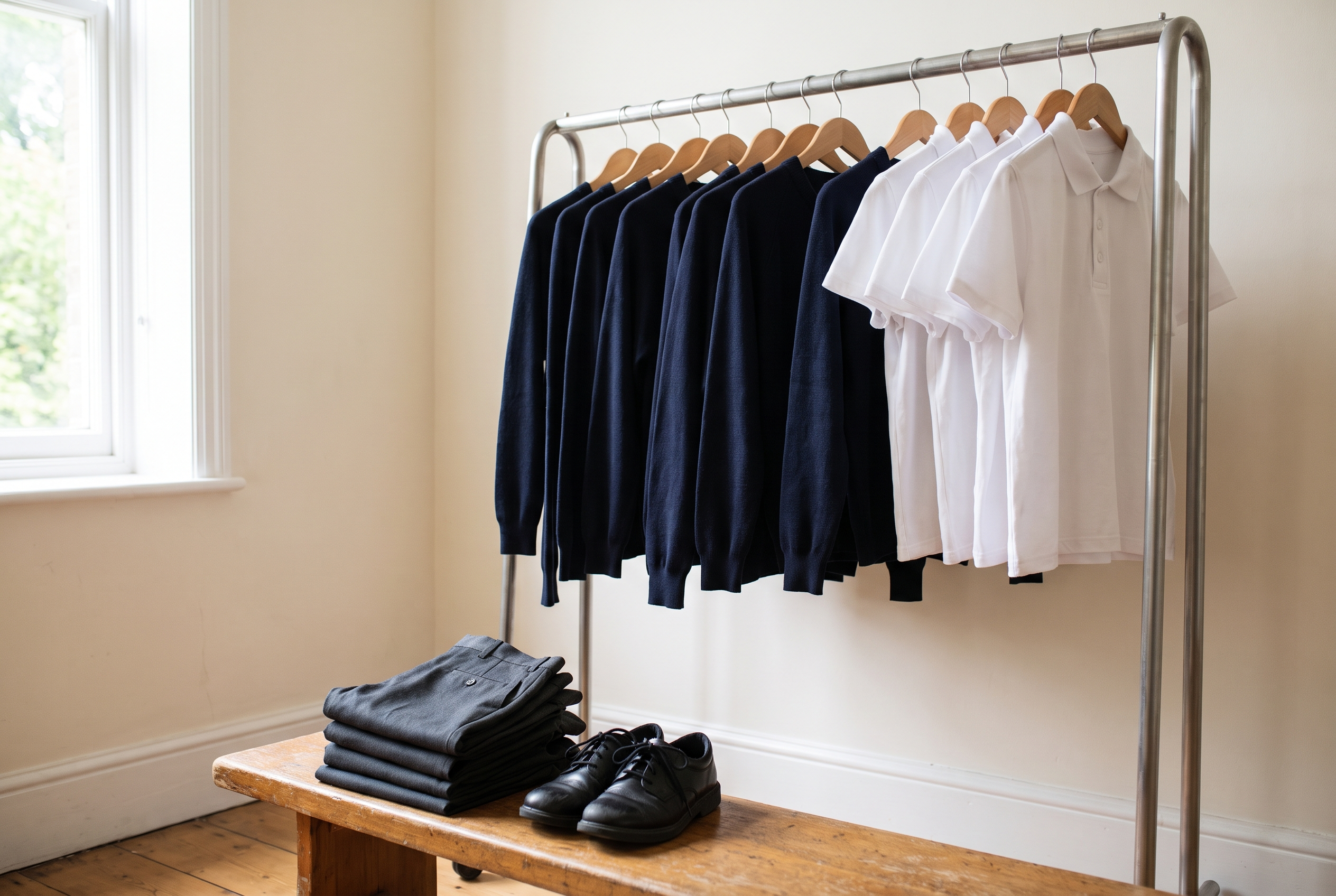
It is worth being clear about what these rules do and do not do. They cap the number of branded items. They do not cap the price of those items. A school could in principle still require three expensive branded items rather than three cheap ones. What has changed is that it can no longer require ten. The rules also do not abolish uniform, and they do not stop schools from having a strict dress code. A school can still require a plain navy jumper, black trousers and black shoes. Those items are simply not branded, so they can be bought anywhere. The "optional" loophole is worth understanding, because it was the main way earlier rules were sidestepped. Guidance already limited compulsory branded items, so some schools listed extra branded items as optional while making it socially obvious that everyone was expected to have them. The new rules require an affordable alternative to exist before something can be called optional. The enforcement power is real but untested. The Education Secretary can now intervene. Whether that happens often, and how quickly, will only become clear over the coming year. Uniform costs are also part of a wider package the government has announced on school costs, including free breakfast clubs and an expansion of free school meals. Those are separate schemes with separate rules, and this article does not attempt to cover them. Finally, this applies to schools in England. Scotland, Wales and Northern Ireland set their own policies.
Practical advice
If uniform costs are a strain, here are things worth doing. Check your school's uniform policy against the new limits. Count the branded items that are genuinely compulsory. Three for primary, four for secondary with one being a tie. If the list is longer, the school should be changing it. Ask about the alternative for anything described as optional. Under the new rules there should be an affordable one. Ask about payment plans. Schools are now required to work with suppliers who offer them, so spreading the cost is a legitimate request, not a favour. Look for second-hand uniform. Most schools run a swap shop or a preloved sale, often through the parents' association. Many local Facebook groups do the same. Children grow out of blazers long before blazers wear out. If you are struggling, ask the school directly. Many schools hold hardship funds, and some local councils run uniform grant schemes. These are rarely advertised loudly, and staff are used to the question. If your child cannot comply with the uniform policy for financial reasons, they should not be excluded from lessons or activities over it. Department guidance is clear on that point. If it happens, raise it with the head teacher. And if you think your school is not following the new rules, start with the head teacher, then the governing body or trust, then the Department for Education.
What to know
From the week of 4 September 2026, schools in England can require a maximum of three branded uniform items at primary level and four at secondary, where one of the four is a tie. Schools can no longer label branded items as optional without an affordable alternative, and cannot pressure families into expensive branded sports kit. Schools must use suppliers who offer payment plans, and must review supplier contracts at least every five years. The Education Secretary can intervene where a school does not comply. The rules limit the number of branded items, not their price, and they do not change what a school may require in terms of colour or style of unbranded clothing. Second-hand uniform, school hardship funds and council grants are all worth asking about, and a child should not be kept out of lessons because their family cannot afford an item. Sources: GOV.UK, "Government acts to crack down on school uniform-rip offs", 4 September 2026, https://www.gov.uk/government/news/government-acts-to-crack-down-on-school-uniform-rip-offs | GOV.UK, "Breathing space for families as government eases school costs", 1 September 2026, https://www.gov.uk/government/news/breathing-space-for-families-as-government-eases-school-costs | West Bridgford Wire, "Schools face tighter rules on costly branded uniforms", September 2026, https://westbridgfordwire.com/schools-face-tighter-rules-on-costly-branded-uniforms/ This article is for general information about school policy in England and does not replace advice from your child's school, your local authority or a qualified professional. If money worries are affecting your family's health or wellbeing, your GP or pharmacist can point you towards local support.
Related articles

A 47-year record broken, glaciers at their biggest loss yet, and a 4,000-year-old piece of ice on a table
On 15 October 2026, the UK launched an updated Arctic Policy Framework. Uma Kumaran MP, Minister for the Polar Regions at the Foreign, Commonwealth and Developm…
Almost a million young people are NEET, and six in ten have never had a job at all
On 15 October 2026, the Department for Work and Pensions and UKHospitality announced a partnership with sixteen of Britain's biggest hospitality employers. The…
Only 14% passed their maths resit. The Education Secretary says that has to stop
On 15 October 2026, Education Secretary Lucy Powell gave a speech to the Confederation of School Trusts conference. Powell was appointed Education Secretary in…