
An invasive mosquito is breeding in London. Here is what that means
What happened
The UK Health Security Agency, known as UKHSA, has found an invasive mosquito breeding in east London. The species is Aedes aegypti. It is sometimes called the yellow fever mosquito. Adult mosquitoes and larvae, which are the young that live in water, were found at residential properties. This is the first time this species has been found breeding in the UK. It is the fourth time it has been detected here in modern times. The earlier finds did not involve breeding. The first report did not come from a laboratory. It came through Mosquito Watch, a scheme that lets members of the public send UKHSA photographs of biting mosquitoes. Someone noticed something, took a picture and reported it. Experts then confirmed what it was. UKHSA has already acted. The larvae have been destroyed. Extra traps have been set. Officials have inspected the area within a 300 metre radius of where the mosquitoes were found, and monitoring is continuing. So far there is no evidence that the mosquitoes or larvae have spread into nearby public areas. There is no evidence that they have caused any human infections. Dr Jolyon Medlock is Head of Medical Entomology and Zoonoses Ecology at UKHSA. He said the risk to the public from this finding is assessed as very low, and that there is no evidence these mosquitoes have caused human infections. He also said the species cannot survive long term in the typical UK climate, which is too cold overall. The news was published on 3 September 2026.
Why this matters
It is fair to ask why a few mosquitoes in one part of London are news at all. The reason is what this species can do elsewhere. In tropical and subtropical countries, Aedes aegypti can spread dengue, chikungunya, yellow fever and Zika. It does that where those infections are already circulating in people, and where the weather is warm enough for the virus to develop inside the mosquito. Neither of those conditions applies in London right now. That is the important part, and it is why the official risk assessment is very low rather than moderate or high. What matters more is the principle. Mosquitoes travel. They arrive in luggage, in shipping containers, in tyres and in plant pots. Warmer summers make it slightly easier for them to survive once they get here. Prof Steven White of the UK Centre for Ecology and Hydrology put it plainly. He said that global movement of people and goods, combined with climate change, means the UK is likely to experience introductions of invasive mosquitoes. That is a forecast about the coming years, not a warning about this month. But it explains why UKHSA responds quickly to a small find. Stopping a species before it settles in is far easier than removing it later.
What the evidence actually says
It is worth separating three different things: a mosquito being present, a mosquito breeding, and a mosquito spreading disease. The first two have happened. The third has not. For local transmission of a disease like dengue, several things have to line up at the same time. Dr Cesar Lopez-Camacho of the University of Oxford explained that you need mosquitoes capable of carrying the virus, a traveller who arrives already infected, temperatures warm enough for the virus to develop, and then contact between those mosquitoes and other people. Take away any one of those and the chain breaks. At the moment, in the UK, the chain breaks in more than one place. Prof Heather Ferguson of the University of Glasgow said that the risk of being infected by any of these diseases in the UK, or in east London, at present remains very low. She also said it is important that this mosquito species does not establish itself in the UK, and argued for sustained investment in monitoring. Temperature is the limiting factor. Dr Lopez-Camacho noted that warmer conditions can speed up mosquito development, lengthen the period when mosquitoes are active, and increase the rate at which viruses copy themselves. British winters currently do the opposite. This is also not a new surveillance effort scrambled together in a hurry. UKHSA and its predecessors have been monitoring mosquitoes across England since 2010, with checks every two weeks from June to October, when mosquito numbers peak. This find is that system working as intended.
Qurexa perspective
We are a healthcare logistics and pharmacy delivery service in Lincolnshire, not a team of entomologists. We are not going to pretend this story sits in our field. What we can offer is the pharmacy angle, because that is where a lot of quiet worry ends up. If you are travelling somewhere that dengue, chikungunya or malaria is present, the useful conversation is with your pharmacist or your GP, and it is worth having a few weeks before you fly rather than the night before. Insect repellent, mosquito nets and, where relevant, antimalarial tablets are all pharmacy conversations. And if you are one of the people we deliver to because getting out to a pharmacy is genuinely hard, this story changes nothing about your medicines. Your repeat prescription still arrives the same way. Nothing here affects the medicines themselves.
Practical advice
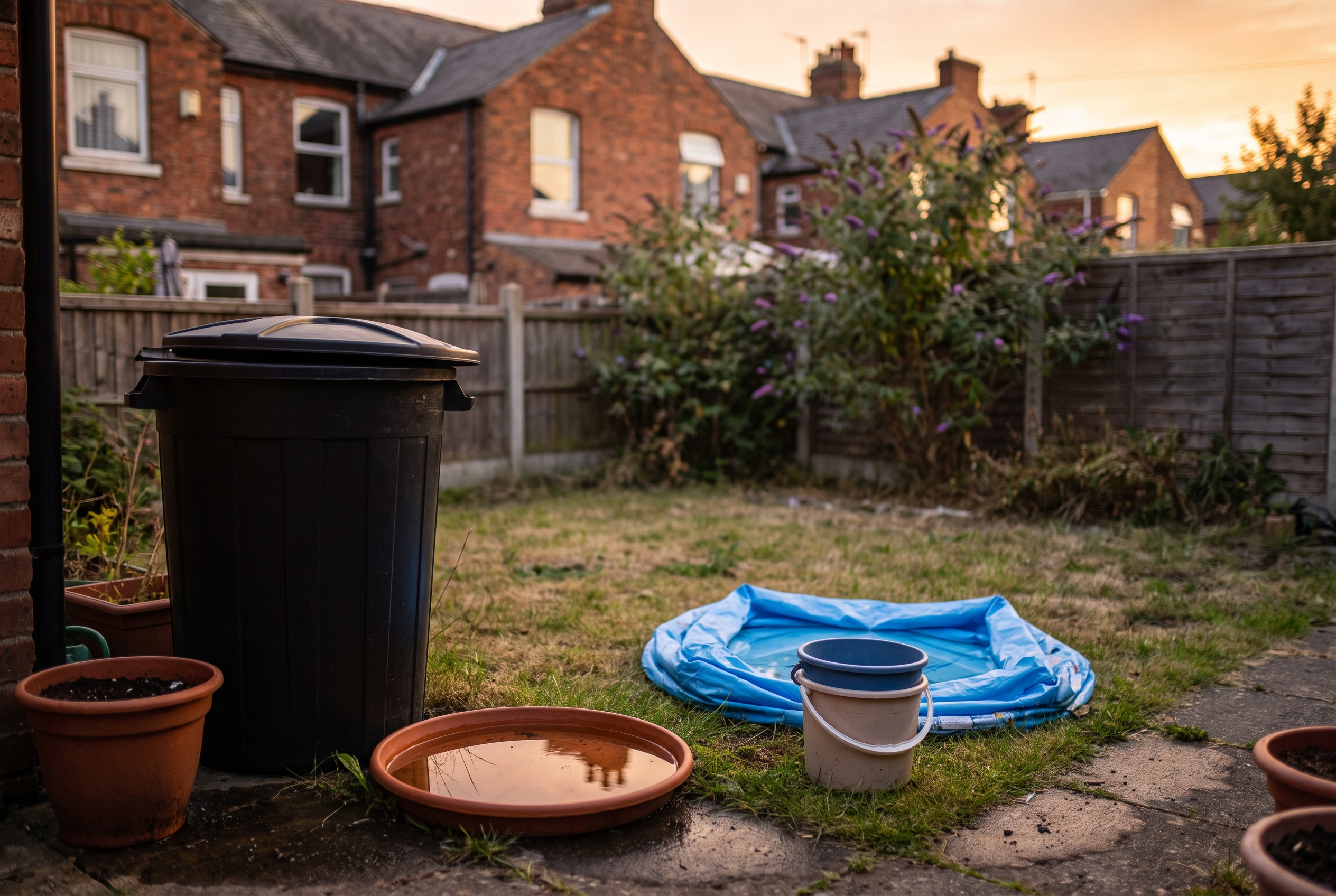
For nearly everyone in the UK, no action is needed at all. But if you would like to do something useful, these are the things that genuinely help. Tip out standing water. Mosquitoes lay eggs in still water, and they do not need much of it. Once a week, empty and turn over the things in your garden that collect rain: plant pot saucers, buckets, watering cans, paddling pools, old toys and forgotten containers. Clear blocked drains and gutters. Put a proper lid on your water butt. That is a five minute job, and it works against ordinary British mosquitoes too, which is a decent reason to do it regardless of this news. Report what you see. If you are bitten by mosquitoes and can photograph the culprit, UKHSA's Mosquito Watch scheme wants to know. You can submit a report online with a photograph. If you can send the insect itself, freeze it for about ten minutes first, put it in a crush proof container, label it with where you found it and include the reference number the online form gives you. Note that UKHSA does not routinely test submissions for viruses, so a submission is about mapping where mosquitoes are, not about diagnosing you. Check your luggage. Dr David Weetman of the Liverpool School of Tropical Medicine suggested that people returning from countries where Aedes mosquitoes are present should check their luggage carefully, and report any sightings to UKHSA. It sounds small. Hitchhiking in bags and cargo is one of the main ways these insects arrive. If you feel unwell after travelling. Mosquito-borne illnesses are far more likely to be picked up abroad than at home. If you develop a fever, a bad headache, joint pain or a rash within a few weeks of returning from a tropical country, contact your GP or call NHS 111, and tell them where you have been. That travel detail changes what a clinician looks for.
What to know
The short version. An invasive mosquito species has been found breeding in the UK for the first time, at homes in east London. UKHSA has destroyed the larvae, increased trapping and is monitoring the area. The official risk to the public is very low. There is no evidence of human infections, and no evidence the mosquitoes have spread into nearby public spaces. The species cannot currently survive a British winter. That is the single most reassuring fact in this story, and it comes from UKHSA itself rather than from us. What experts are asking for is not alarm. It is attention: keep the surveillance funded, keep reporting sightings, and keep water from sitting still in the garden. This particular find was spotted because an ordinary person reported an unusual mosquito. That is worth remembering the next time you see one. Peak mosquito monitoring runs until October, so the next few weeks are when a report is most useful. Sources: UK Health Security Agency (GOV.UK), 'Invasive mosquito species detected in east London', 3 September 2026, https://www.gov.uk/government/news/invasive-mosquito-species-detected-in-east-london. UK Health Security Agency blog, 'Should I be concerned that an invasive mosquito species has been detected in East London?', 3 September 2026, https://ukhsa.blog.gov.uk/2026/09/03/should-i-be-concerned-that-an-invasive-mosquito-species-has-been-detected-in-east-london/. Science Media Centre, 'Expert reaction to news from UKHSA that an invasive mosquito species (Aedes aegypti) has been detected in east London', 3 September 2026, https://www.sciencemediacentre.org/expert-reaction-to-news-from-ukhsa-that-an-invasive-mosquito-species-aedes-aegypti-has-been-detected-in-east-london/ This article is for general information and does not replace advice from a doctor, pharmacist or other qualified healthcare professional. If you feel unwell after travelling abroad, contact your GP or NHS 111 and tell them where you have been.
Related articles

47% stayed off, 14% called anyone: what 68,000 surveys say about how we handle flu
On 15 October 2026, the UK Health Security Agency (UKHSA) published new findings about what people actually do when they come down with flu-like symptoms. The…
One dose, not two: what WHO's advisers have just said about the HPV jab
The World Health Organization's expert vaccine panel has changed its advice on the HPV jab. The panel is called SAGE, short for the Strategic Advisory Group of…
3.5 million deaths a year, and no level of it is safe
On 15 October 2026, the World Health Organization (WHO) published an update calling on countries to speed up action against lead poisoning. It came just before…