
MHRA: Always Use a Filter When Giving Nutrition Through a Drip
What happened
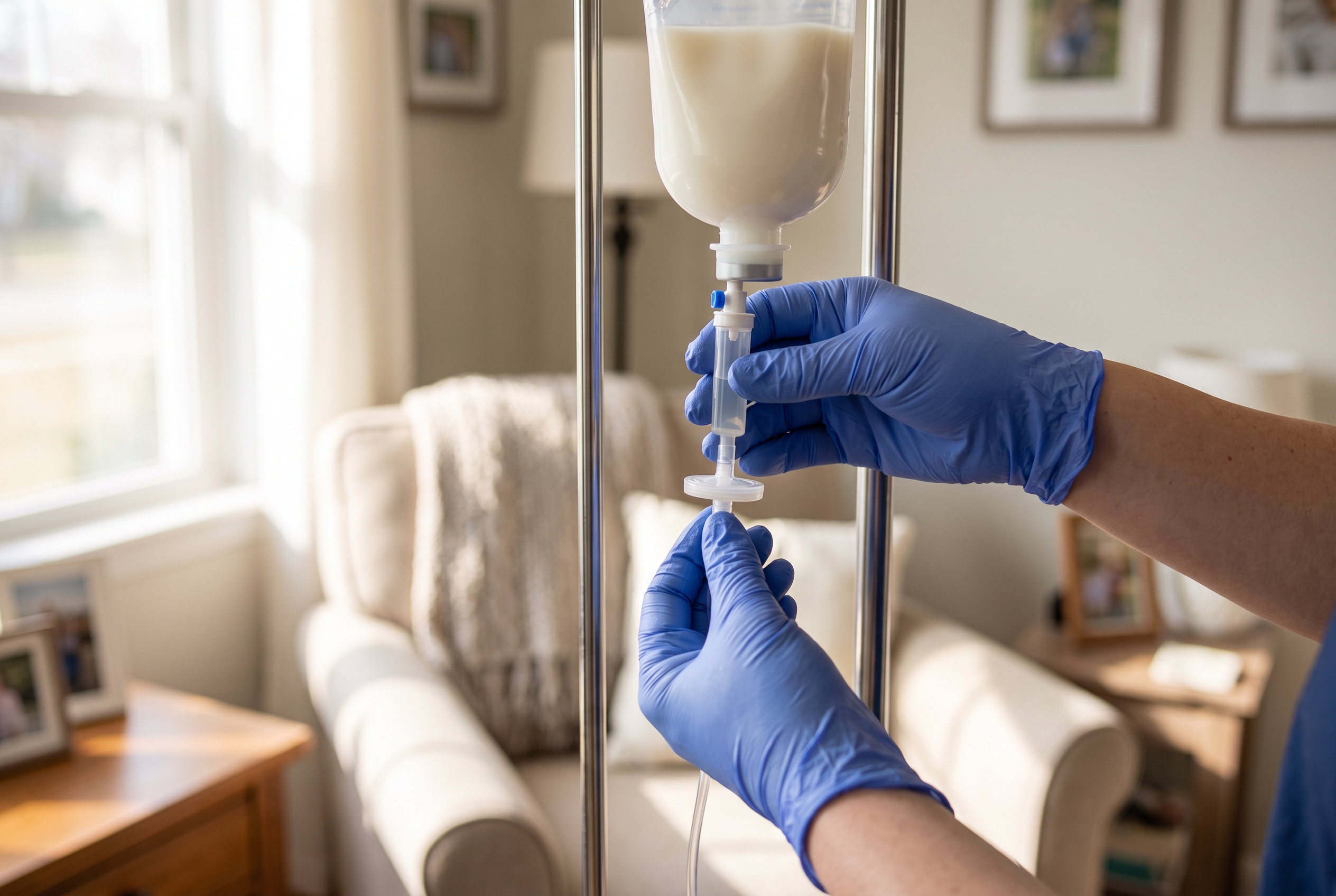
On Wednesday 2 September 2026, the Medicines and Healthcare products Regulatory Agency (the MHRA), which regulates medicines and medical devices in the UK, issued a new safety alert. Its message is short: a filter should always be used when parenteral nutrition is given, in every care setting. Parenteral nutrition, often shortened to PN, is liquid nutrition delivered through a drip, straight into the bloodstream, bypassing the stomach and gut completely. People need it when their digestive system cannot take in enough nutrition on its own: after major bowel surgery, during some cancer treatment, or with certain long-term gut conditions. Some very premature babies need it too. The MHRA's advice sets out what the filter should be: - every parenteral nutrition solution should be given through a filter with a pore size no larger than 1.2 micrometres - where the solution is clear and contains no fat (called an aqueous or lipid-free solution), it is good practice to use a finer 0.2 micrometre filter - filters built into the giving set are preferred, but a separate "add-on" filter is a suitable alternative, as long as infection control rules are followed - the filter and the giving set should be changed with each new bag of feed A micrometre is one thousandth of a millimetre, so these filters catch things far too small to see. One phrase matters most: "for patients in all care settings". That means hospital wards and intensive care, but also care homes and people's own homes, where patients and trained family carers sometimes set up their own feeds. The MHRA published the advice twice on the same day: as Device Safety Information DSI/2026/011, and as a Drug Safety Update.
Why this matters
This is not a product recall. No brand of feed is being withdrawn, and nobody is being told to stop treatment. The alert is about how the feed is delivered, not about the feed itself. The reason behind it is serious. The MHRA states that giving parenteral nutrition without a filter "has been associated with a number of adverse incidents including an embolism which resulted in a fatal outcome". An embolism is a blockage in a blood vessel, caused by something that should not be in the bloodstream, such as a bubble of air or a clump of solid particles. The review also began for a specific reason. A coroner had issued a Regulation 28 Prevention of Future Deaths report: a formal report written after an inquest when a coroner believes more deaths could follow unless something changes. Coroners do not issue them lightly. When the MHRA looked into it, it did not find one broken product. It found something more ordinary, and in a way more troubling: the guidance did not agree with itself. Different suppliers gave different advice on their packaging and leaflets, and some of it did not match what the specialist professional bodies recommended. The MHRA's own words are that it "identified inconsistencies in recommendations which may result in variability in clinical practice". In plain terms, depending on which product a patient was given and which leaflet a nurse or carer read, the filter might or might not be used. That is exactly the sort of gap safety alerts exist to close. Parenteral nutrition is not a common treatment, but for the people who depend on it, it is life-sustaining, and it is already treated as high risk: the mixture must stay chemically stable, germs must be kept out, and it needs close monitoring.
What the evidence actually says
The MHRA explains that a filter has two jobs: to stop air getting into the line, which is what can cause an air embolus, and to catch particulate matter, meaning tiny solid bits. Those bits come from several places: the plastic tubing and connectors, the nutrition mixture itself, the handling involved in connecting parts, and crystals that form when nutrients react with each other or with another medicine given through the same line. Why does that matter? Because, as the alert puts it, particles "can be deposited in the microvasculature of organs and have serious clinical consequences". The microvasculature is the network of the smallest blood vessels, and organs such as the lungs are supplied by them. A particle lodging there is not harmless. Fat matters too. Parenteral nutrition often contains a lipid emulsion, which is fat suspended in liquid, and if that emulsion becomes unstable, larger globules form. Filtration removes them. That explains the two sizes: 1.2 micrometres catches problem particles and unstable globules while letting a normal emulsion through, and 0.2 micrometres is finer still, used where there is no fat to block it. One line guards against complacency. Filters, the MHRA says, "are not a substitute for appropriate manufacturing controls or aseptic technique, but an added risk minimisation measure". A filter is a safety net, not permission to be less careful about clean hands and clean connections. This is not one regulator acting alone. The MHRA points to a position statement from the British Pharmaceutical Nutrition Group supporting routine filter use, endorsed by the British Association for Parenteral and Enteral Nutrition, the Neonatal and Paediatric Pharmacy Group and the National Nurses Nutrition Group. The specialist pharmacists, nutrition clinicians and specialist nurses have all landed in the same place, and the MHRA has now asked every supplier to update its product information so the labels match the advice. It is equally important to say what the alert does not claim. It does not say a particular brand is unsafe, it gives no number of people harmed, and it does not ask anyone to stop their nutrition.
Qurexa perspective
We should be straightforward: Qurexa does not supply parenteral nutrition. This kind of feed comes through specialist homecare services arranged by hospital nutrition teams, along with the pumps, giving sets and training that go with it. If you are on PN at home, your hospital team and your homecare nurse are the right people to speak to, not us. But the wider pattern is one we see every week in Lincolnshire. More treatment now happens at home rather than on a ward. Medicines arrive at the door, and families learn to do things that used to be done only by clinical staff. That shift is largely a good one, and this alert shows it only works when the small print travels with the treatment. A filter is a tiny plastic part. Whether it gets used at home comes down to whether someone was trained, whether the right giving set was supplied, and whether the leaflet in the box said the same thing as the specialist guidance. Here, for a while, it did not. The medicine is only half of it: knowing how to use it safely, and having someone to ring when you are unsure, is the other half.
Practical advice
If you or a family member has parenteral nutrition at home: - Do not stop your feed. This is not a recall and not a reason to skip treatment. - Look at your giving set. Many already have a filter built in, which is the option the MHRA prefers: a small housing partway along the tubing. - If your set does not have one, an add-on filter is needed. Ask your homecare nurse or hospital nutrition team before your next feed if you are unsure. - If an add-on filter is now needed, you should be given proper training on it. The MHRA says so directly. Ask for it. - Change the filter and the giving set with each new bag, following your team's instructions. - Never use a filter that was not supplied for parenteral nutrition, and never reuse one. - Keep your usual clean technique exactly as you were taught. The filter is an extra layer, not a replacement. If you work in a care home or in community nursing, the alert asks providers to make sure local protocols name filter use as standard practice, and to check that giving sets and their filters are compatible with the infusion pumps in use. If something goes wrong, report it. Suspected side effects, and device problems in England, Wales and Northern Ireland, go to the Yellow Card scheme. In Scotland, device incidents go to the Incident Reporting and Investigation Centre. Reports from patients and carers count too, and they are how patterns like this one get spotted.
What to know
- On 2 September 2026 the MHRA said filters should be used whenever parenteral nutrition is given, in all care settings including at home. - The pore size should be no larger than 1.2 micrometres, with a finer 0.2 micrometre filter as good practice for clear, fat-free solutions. - Giving PN without a filter has been linked to adverse incidents, including an embolism that resulted in a death. The review followed a coroner's Prevention of Future Deaths report. - The MHRA found suppliers' guidance was inconsistent with specialist recommendations, and has asked suppliers to update it. - It is not a recall. No product is being withdrawn and nobody should stop treatment. - Patients and carers giving PN at home should check whether their set has a built-in filter, and ask about training if an add-on filter is needed. - Problems can be reported through the Yellow Card scheme, or IRIC in Scotland. Sources: MHRA (GOV.UK), "Filters should be used during the administration of Parenteral Nutrition for patients in all care settings DSI/2026/011", Device Safety Information, 2 September 2026, https://www.gov.uk/drug-device-alerts/filters-should-be-used-during-the-administration-of-parenteral-nutrition-for-patients-in-all-care-settings-dsi-slash-2026-slash-011 ; MHRA (GOV.UK), "Filters should be used during the administration of Parenteral Nutrition for patients in all care settings", Drug Safety Update, 2 September 2026, https://www.gov.uk/drug-safety-update/filters-should-be-used-during-the-administration-of-parenteral-nutrition-for-patients-in-all-care-settings ; BAPEN, "BPNG Position Statement - Use of filters during the administration of parenteral nutrition", 23 October 2024, https://www.bapen.org.uk/other-news/bpng-position-statement-use-of-filters-during-the-administration-of-parenteral-nutrition/ This article is for general information and does not replace advice from a doctor, pharmacist, specialist nutrition nurse or other qualified healthcare professional. If you or someone you care for receives parenteral nutrition, do not change anything about your treatment or equipment on the basis of this article. Speak to your hospital nutrition team or homecare nurse first.
Related articles

47% stayed off, 14% called anyone: what 68,000 surveys say about how we handle flu
On 15 October 2026, the UK Health Security Agency (UKHSA) published new findings about what people actually do when they come down with flu-like symptoms. The…
One dose, not two: what WHO's advisers have just said about the HPV jab
The World Health Organization's expert vaccine panel has changed its advice on the HPV jab. The panel is called SAGE, short for the Strategic Advisory Group of…
3.5 million deaths a year, and no level of it is safe
On 15 October 2026, the World Health Organization (WHO) published an update calling on countries to speed up action against lead poisoning. It came just before…